

In my memory, it was the only cold day in Boulder all winter, a frosty Monday morning on the cusp of spring. My sister, driving my Subaru, crept down the icy switchbacks of Flagstaff Road as I sat in the passenger seat, watching diffused sunlight ripple across the eastern plains.
“If this is the last sunrise I ever see, at least it’s a good one,” I thought, because I am particularly overwrought when I am stressed. Surgery is scary. The idea that strangers are going to render me unconscious and slice into my body — I don’t understand how anyone can be blase about it. Well-meaning friends who heard I had a torn meniscus reached out with tips on how to avoid the knife. I didn’t blame them; I hadn’t understood much about this injury before I collapsed into a ditch while running and couldn’t get up again. But a torn meniscus can mean so many things. In my case, the root of the medial meniscus on my left knee completely detached from its anchor in the bone. Sharp edges of broken tissue drifted into my joint space and were trapped against my medial collateral ligament. In addition to feeling like a knife was cutting my knee from the inside out, the meniscus lost all of its shock-absorbing power, exponetially spiking the contact pressure on my cartilage. In an instant, I was “bone on bone.”
The injury was so painful; I can’t even quantify it, as one can never quantify pain in a way anyone can understand it. I can only say that it was the most physical pain I have experienced, due to the length of time I lived with my torn meniscus root. 31 days. Frostbite was more painful, but the worst lasted only hours. Crashing my bike into a rut on the Stevens Creek Trail and ripping open my right elbow so dramatically that I spent three hours in the ER having it scrubbed with a wire brush without painkillers was more painful — but in that case, I writhed sleeplessly for just a few days. This meniscus tear was a month of searing pain that did not improve even a little in all of that time. I subsisted on Aleve and then just Tylenol, which did almost nothing to take the edge off. I couldn’t put weight on my knee and had no choice but to use crutches, even before they were a requirement of the surgical recovery. This wasn’t an “oh, I have a bum knee, and it hurts to run” injury. This was a source of severe chronic pain that left me hobbled and was never going to heal on its own.
I’d spent the past month only half-joking when I begged Beat to cut my leg off or, better yet, mercy killing. I have the greatest respect for people who have no choice but to live with chronic pain. These people are stronger than the most decorated athletes. I am not that strong.
But on March 16, it was finally my turn to reap the rewards of modern medicine and not spend the rest of my likely shortened life using a cane as I would have in the 19th century. I couldn’t wait to have surgery. But damn, I was afraid.
The meniscus root repair went as well as it could have. After the procedure, my surgeon told my mom and sister that my knee cartilage was in surprisingly good shape. She cut away some of the fraying beneath the patella that is typical in most middle-aged runners. But my injury was not degenerative. The time between a reasonably functional meniscus and a completely torn one could likely be measured in minutes. My quick shift to crutches saved me the usual bone-on-bone grinding after the meniscus detached, so I experienced minimal cartilage wear.
There are many paths to a root tear, but mine was most likely an acute injury. The fact that it seemed to come on suddenly without blunt force perplexes me. My memory of what happened before feeling that sudden blinding pain is foggy — pain is like that — but I think I likely did take a bad step into a ditch while I was walking along a steep embankment on the left side of a gravel road and looking at my phone (texting Beat about another injury.) I was having severe ITB pain at the time, which may or may not be related, but it was causing me to take wide, poorly balanced steps. I suspect a partial tear may have been present for a long time. I take so many falls, and I badly wrenched this knee after slipping off a boulder while racing the Tor des Geants in 2014.
Those many, many falls and the “score” my body keeps are why I suspect my ship to aging gracefully has already sailed. But for now, I had to focus on that long recovery. The surgical procedure comes with a strict protocol that includes a mandatory six weeks of non-weight-bearing, using crutches to ambulate, and keeping the knee locked in a heavy brace, even while sleeping. Those six weeks were tedious and interminable, and I did a lot of complaining on my blog. But I wasn’t in pain. After waking up from surgery in quite a bit of pain, it diminished quickly. For the first two weeks, I did take a small dose of oxycodone to sleep, which was more than I ever had when I was in real pain. But still — to just have the pain disappear. Incredible. It was as though the sun came out after a long period of rain, and I could see flickers of light on the horizon.
It’s hard to rehash six months of recovery. But for those who wonder what the process might look like, here is a truncated timeline:
March 16 to April 27. Mandatory non-weight-bearing. Scooting my butt across the bathroom to climb onto a shower chair to take a shower. PT twice a week, mainly simple exercises such as quad sets and heel slides. Clinging to some of my old athletic ego by taking my crutches to the gym for seated weight-lifting and single-legged rowing. I also did single-legged spinning on my indoor bike at home. 65 watts on a good day. Talk about ego death.
April 27 to May 3: Begin the slow return to weight-bearing with crutch walking. I needed two crutches for the first week. I would be fully exhausted after a 40-minute mile around the park. PT progressed to wall sits and squats, and also went into its humiliation phase that I don’t want to relive.
May 4 to May 10: One crutch walking progressed to walking flat paths with trekking poles, still exhausted in the 30-minute-mile range. Beat retrofitted my indoor bike with “short” cranks so I could pedal at a 90-degree angle, and I took to cycling with verve. By May 10, I was pedaling 25 virtual miles. I described the weird juxtaposition of fitness in a Strava post: “It's a little bewildering that I still essentially cannot walk, but put me on my short cranks in a controlled setting and I am quickly getting stronger. I think I long suspected that cycling fitness does not translate to functional fitness, but now I know for sure. I am glad to have this, though, because the walking thing has been pretty demoralizing.”
May 11 to May 31: Lots of Zwifting, weight-lifting, and still one-legged rowing, because I felt weaker trying to use two legs. I quit my physical therapist at the Boulder Orthopedic Center during this time, ending the weekly humiliation ritual. I used my great privilege to pay out of pocket and focused my work with two great therapists at Pace West PT and Build Sports Performance. I continued to struggle with re-learning how to walk and needed to wear my brace for support. I started venturing on “hikes” that were slow walks on paved park roads that were still closed for the season. I called these activities “Toddling in the Mountains.”
June 1-7: I traveled to Utah to help my mom start her moving process away from my childhood home. I managed to walk 20 miles over the course of the week, in the 24-minute-mile range, complaining about “this rusty hinge that used to be a knee.”
June 8-21: I officially passed the 12-week post-surgery mark and was cleared to bend my knee past 90 degrees, which meant I could ride a bike outside. My first rides were awkward, but I quickly settled back in as though I’d never left the saddle. I gave up on walking until June 21, when I embarked on a 5-miler. “I haven't attempted a walk in two weeks because I become so frustrated about the disproportionate struggle in this way of moving. But I will never get through the wall if I don't keep pushing.”
June 22-July 5: I finally started to turn a corner with my walking practice. A large part of my struggle was in my brain — that aspect of my proprioception switched off while I moved through the world on crutches, and it was extremely difficult to turn it back on. I moved up to five-hour rides on my mountain bike, easily holding an average of 135 watts, which was my typical casual long-ride pace before my injury. On July 5, I attempted 100 miles on my indoor bike and stopped at 65, having found the limits of my quad strength.
July 6-22: I continued to complain about being hot and unmotivated to walk. I traveled back to Utah to help Mom complete her move. On July 17, I embarked on my first real hike post-surgery — 5.5 miles with 1,300 feet of climbing with my sister, 13-year-old niece, and 7-year-old nephew to Albion Basin in Utah. Ego death commenced after vertigo set in while working my way up the rocky steps to Cecret Lake. To get back down, I had to sit on the trail and lower my body down the most minimal rock steps that 3-year-olds were bounding down.
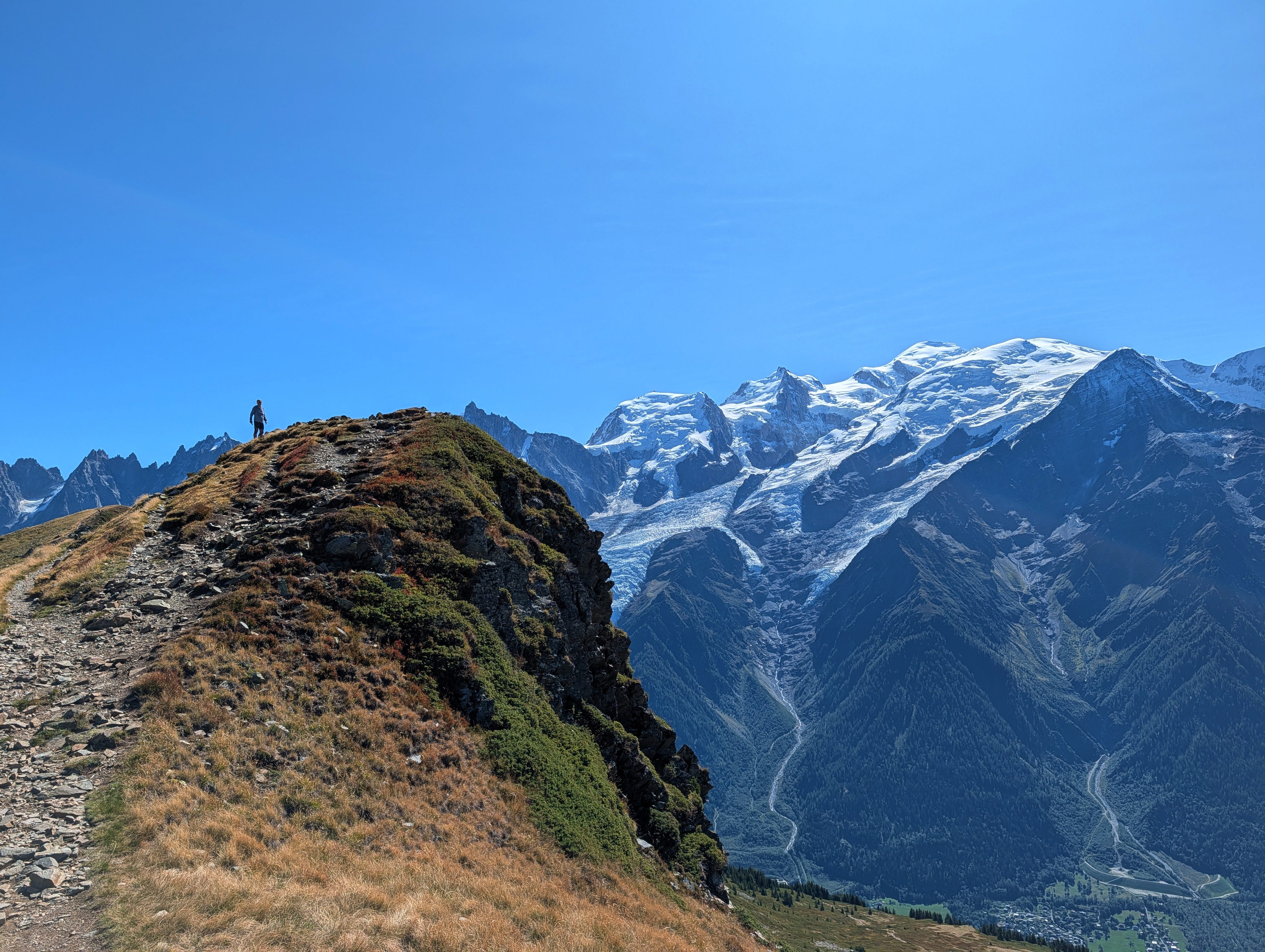
July 23-26. We traveled to France on July 22. It’s wild to realize that only a week passed between my first post-surgery hike in Utah and my second here in Cordon, during which I felt significantly stronger and more comfortable. The Alps are magic, but really it’s the power of positive thinking that works its own sorcery. On July 26, I made it up Tete Noire, 5 miles and 2,300 feet of climbing. “Steep steep downhill and my knee did okay. It complained a bit for the last half mile, and I'm still so slow, but this went better than expected. My strength is building so slowly but it is building.
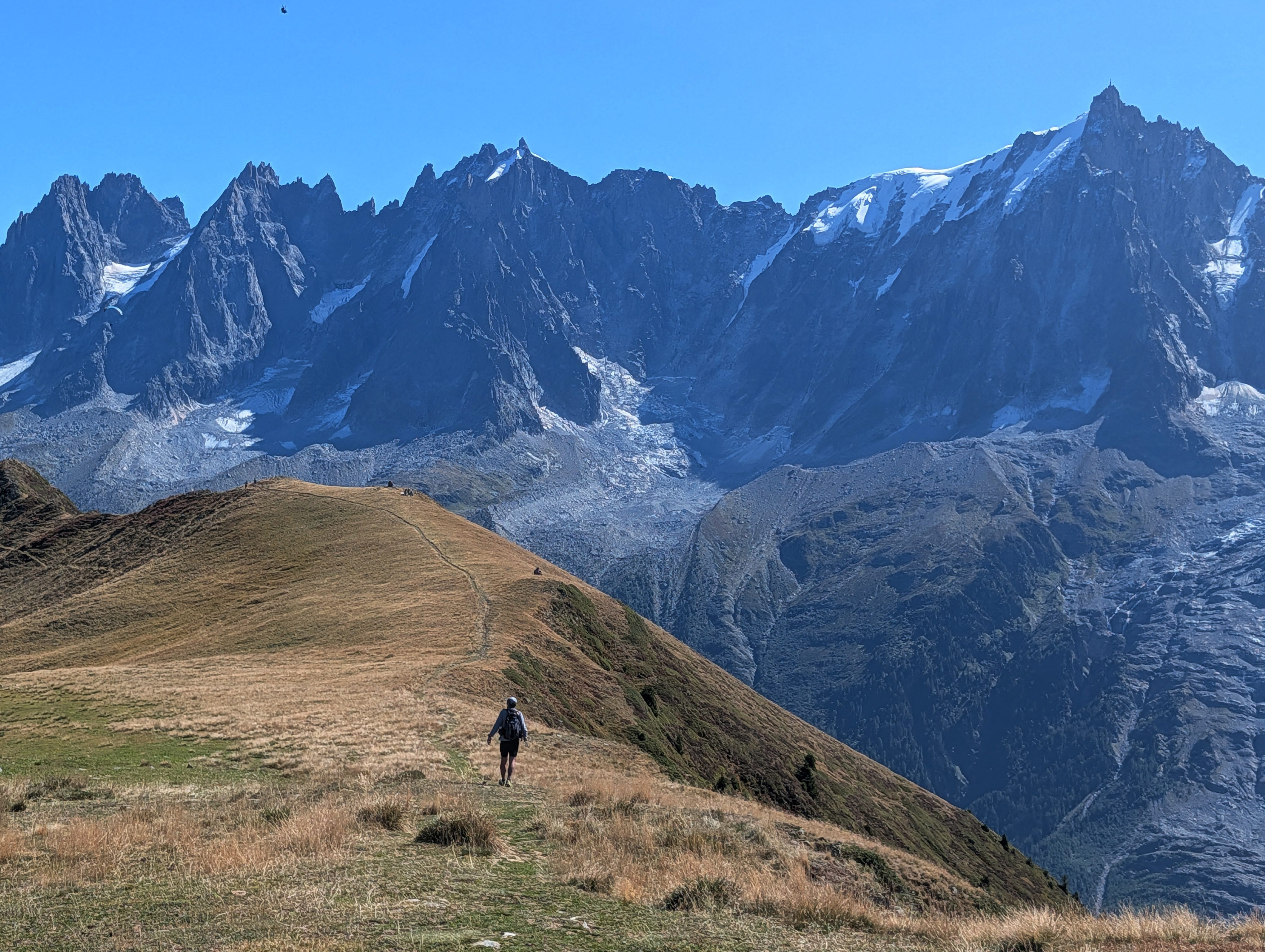
July 27-present. I have been very active here in France, often logging 22 hours a week on Strava. I joined a local gym and still endeavor to keep up with my weightlifting routine and PT exercises at least twice a week. I’ve done a few tough rides on my mountain bike, including a “Birthday 100K” with 10,000 feet of climbing in 10 hours on Aug. 19. I’ve worked my way up to as much as seven hours of hiking, with as much as 6,000 feet of elevation gain (everyone in the Alps knows that horizontal distance doesn’t mean much here, but I’m up to 13 miles in that department). I can only hike every other day at best. If I get greedy and hike two days in a row, my knee becomes stiff and sore. But if I take that day off to do something else, I have almost no lingering pain or weakness. I am amazed by the leaps and bounds my ambulation has improved since July. When I feel frustrated that I can’t keep up with Beat, I remind myself that two months ago, I couldn’t even keep up with my 7-year-old nephew.
Back in February, during my pre-op consultation, my surgeon used gentle tones to lay out the root repair recovery protocol, which most patients view as especially harsh. I shrugged and nodded through the timeline … six weeks, 12 weeks, 16 weeks in purgatory. I didn’t care. As I tried to convey earlier, I was in enough pain that amputation could have been on the table, and I’d have considered it. (Really, I am not good with pain, and it’s humorous that I ever considered myself “tough” just because I like the cold and used to run long distances.)
After cautioning about the dangers patients can encounter during months four and five, the surgeon perked up. “If everything goes well, a full return to activity is feasible in six months. You’ll see! After six months, this will all feel like a bad dream.”
I didn’t remotely believe her. I’d already spent hours on Reddit forums and knew the minimum for feeling normal was at least a year. Plenty of posts were like, “I’m at eight months and still can’t walk down stairs.” This is what I expected, and I was okay with any future difficulties, as long as the doctor could take away my pain.
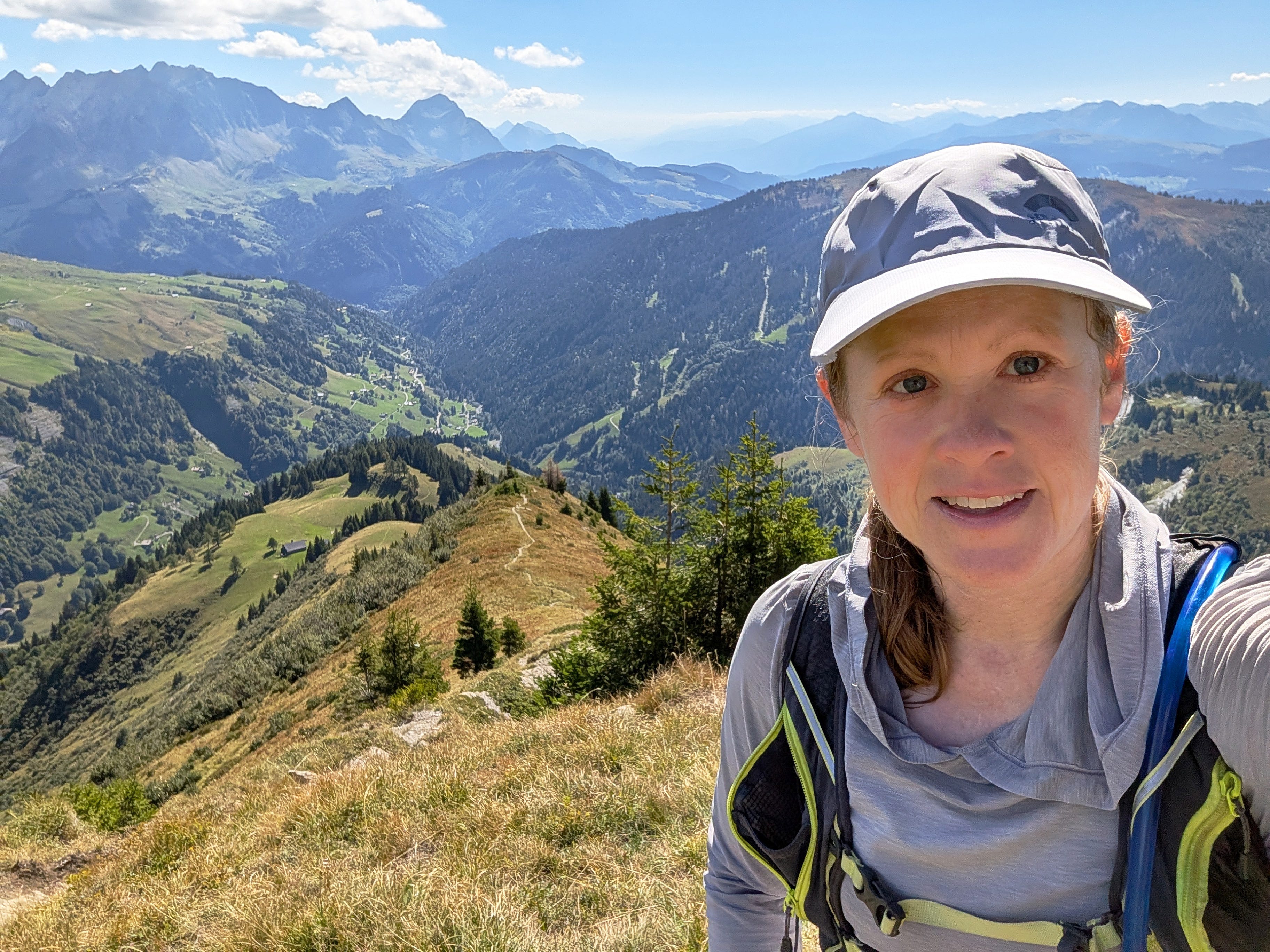
And here I am, six months later. I’m not yet back to “normal,” but I’ve come so much farther than I believed possible just two months ago. On Sept. 15, I decided to check out a tough loop that Beat had scouted the day before, which included my first venture on a “T3” rated trail (this is the equivalent of Class 2+ in the US.) It had a vertical mile (5,250 feet) of climbing over 10 miles. But the crux was the west ridge of what we’ve come to consider our French home mountain, Grand Croisse Baulet. The faint path along the spine gains more than 3,000 feet in two miles, topping out at 40%-plus grades.
Beat recommended the route for its time in the hidden valley below the west ridge, which almost immediately feels more wild and far away than our popular side of the mountain. It was a lovely afternoon with perfect September weather — still warm, but with a persistent cool breeze that carries the sweet aromas of autumn. The tundra has shifted from its summer green to crimson and gold. My leg felt strong and steady on my first steep descent. But then I reached a trail sign that indicated the distance and expected travel time to Grand Croisse Baulet: 3.3 kilometers, 3 hours and 15 minutes.
What kind of trail goes at a kilometer an hour? As a runner, I could move well ahead of the predicted pace of these signs, but my current state of fitness is more typical of an average Alpine hiker. I considered turning back toward the known challenges I’d already crossed. But my old athletic ego was still back there, somehow not destroyed by its many ego deaths of the past six months, admonishing me to be brave.
Back home in Boulder, Beat has a secret route up the west ridge of South Boulder Mountain that we call the “Hairy Backside,” which he loves and I despise for the same reasons. It’s relentlessly steep, like so steep that the slowest you can go still leaves you gasping, and it finishes with big step-ups on boulders where slipping could be perilous or even fatal. Grand Coisse Baulet seems to have its own hairy backside, and like most things in the Alps, it’s three times as large.
But I … loved it? My muscular fitness still has yet to catch up with my former cardiovascular fitness, so it’s almost impossible for me to max out my heart rate with exercise. But I was in this steady tempo state where the world became very small, only as large as my next step up the mountain. The flow continued through moments that were simultaneously minutes, only to be broken by my left quad muscles finally failing on one of the big step-ups. I lifted my leg so my knee was almost against my chest and attempted to pull my entire body up using only that leg. So much pressure on that fragile knee! I only stopped myself midway when I suddenly had a mental image of my quad giving out and the knee tearing in half all over again, at which point I would probably collapse onto my butt and then start rolling hundreds of feet down the steep grassy hillside.
My imagination can be particularly overwrought when I am excited. But common sense prevailed, and I began calculating my steps so I would use my right leg for the big step-ups. Ultimately, I managed it without mishap and “only” needed an hour and 40 minutes to complete the 3.3 kilometers. It’s not going to win me any VK awards, but I was chuffed that I’m already nearly twice as fast as the “typical” Alpine hiker.
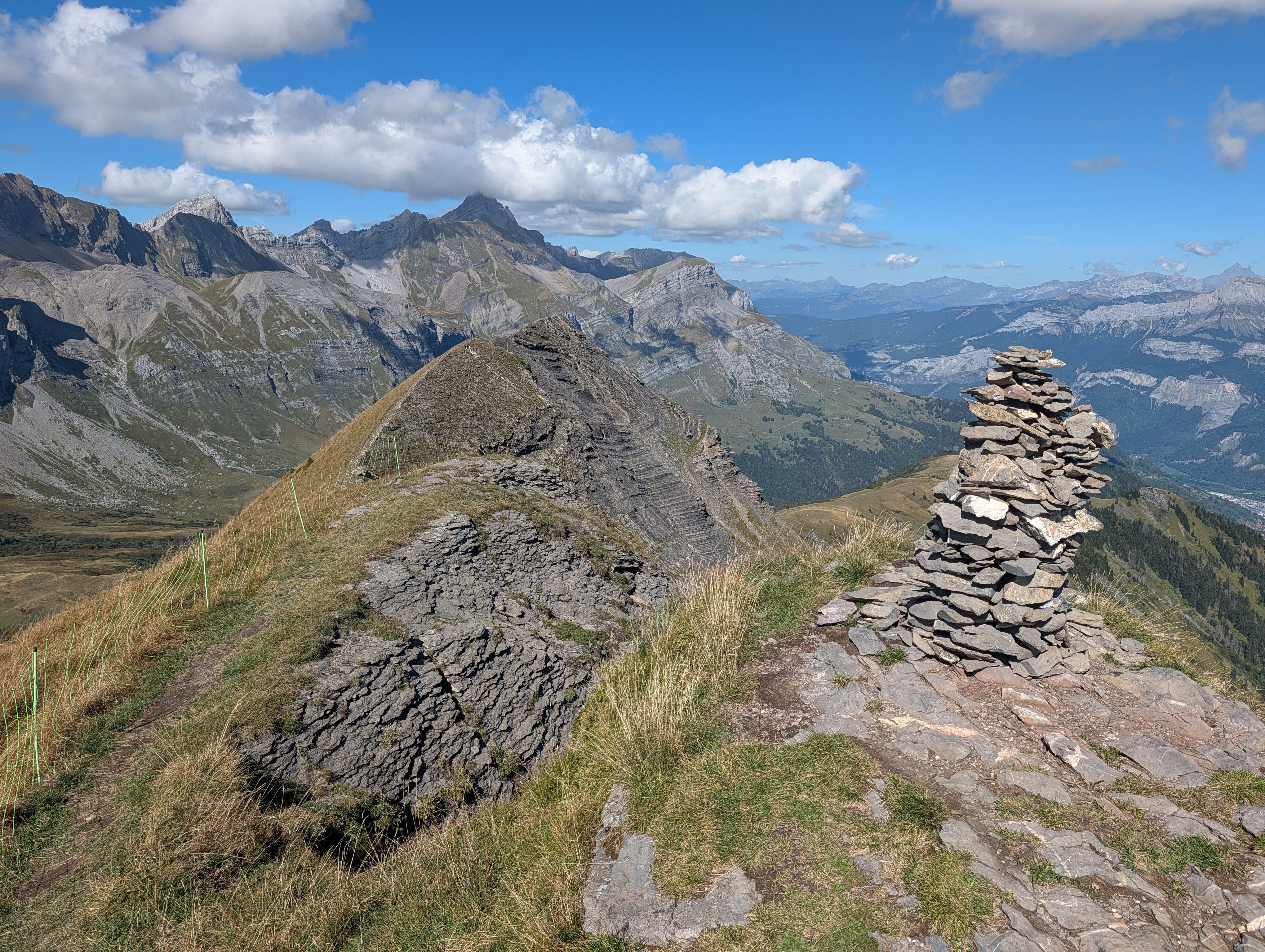
I feel a level of confidence and optimism that I never expected to feel, well, ever again … let alone just six months after surgery. But it’s difficult to guess what the next six months will look like. While climbing toward Aiguillette des Houches on Sunday, Beat and I ran into an old friend whom we haven’t seen in years. After the reintroductions, she asked us the next question runners usually ask each other — what are you training for? What’s next?
The question caught me completely off guard, because I don’t expect people to think of me as a runner who aspires to feats of athleticism. I guess the many ego deaths my injury inflicted have managed to erase that image from my mind. I sputtered for a minute. “Well … I just had knee surgery.”
“Oh right, recovery,” she nodded knowingly, then continued talking about winter racing with Beat.
After we parted, I spent a few minutes being irrationally angry, because why does it always have to be about feats of athleticism? (Our friend is a talented runner who currently works full-time as a sponsored athlete, so there’s that.) Then I realized that my misplaced anger was actually directed inward, because that is something I want to have … a goal … a dream. I want to breathe that fire again. But I also don’t want that because the burning world doesn’t need my silly little dreams, and I’m grateful for what I have, and pain is bad, and aging is catching up to me, and my limbs are riddled with scars, and the body keeps the score, always keeps the score.
When you literally break down on your feet, hit the ground, and can’t get up again … that fear sticks with you.
But when you get stronger by the exponential leaps that I’ve experienced in the past few months, you can’t help but wonder just how high this arc climbs.
As an active 68 year old, my thoughts are always, "I'm in it for the long run." I would rather take a few less risks and keep moving everyday than to injure myself and take time in recovery. Every day feels more precious than I ever imagined. Especially since seeing my husband die at what seems like a very young 65. A big reminder for me to savor every minute.
I've enjoyed following your recovery and am glad to see its going so well. I'm also recovering from an attempt to repair articular cartilage in November (not really sure it worked), and although it's been incredibly frustrating, I certainly have more empathy now for people who live in chronic pain. I can also relate to thinking about what's truly important for me to be able to do with my physical body going forward, and trying to dodge the "what are you training for" question!