

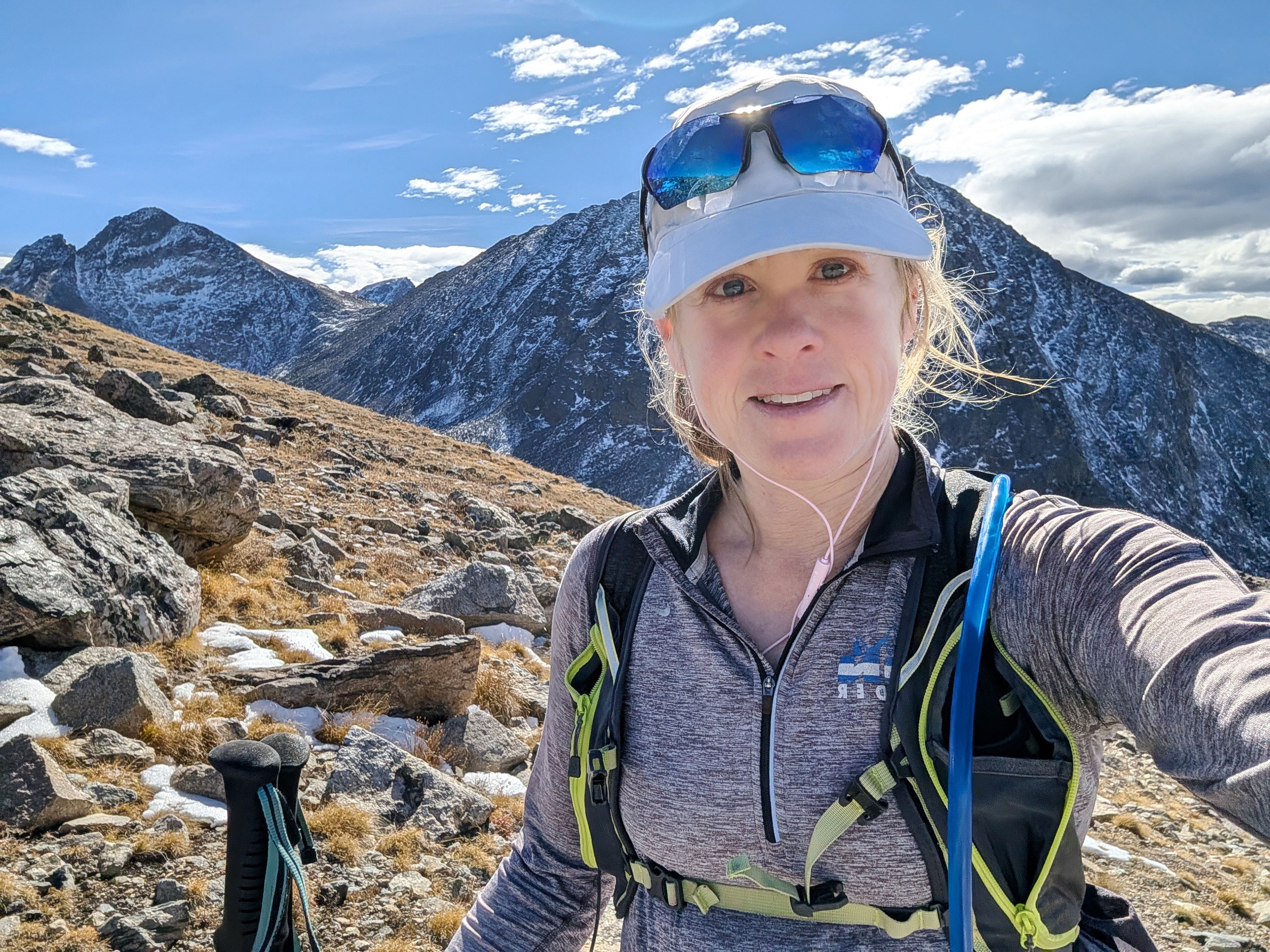
It’s the beige season in Colorado, and I’ve been stumbling over motivation to go outside. Putting a winter race on my calendar has always helped. This will be the first season in 20 years that I haven’t had anything on the horizon; even in 2021, I was knee-deep in every virtual race I could find or create.
I thought about putting something on the calendar. Maybe a bike race. Maybe even a 50K! But no, getting back to running has been physically and mentally frustrating. Feeling a bit beaten up after a half hour on the treadmill has not inspired confidence. And although I understand the importance of slow builds, I’m ready for a break from the endless work of recovery. I had to re-learn how to walk this year. I’m tired. Reinjury is a constant fear. A winter of meeting myself where I’m at rather than constantly pushing for more sounds like a good thing.
Staying satisfied with the status quo is not nearly so simple.
I’ve been steeped in that particularly cloying kind of nostalgia, remembering how limitless the world used to feel when I was young. I was battling this wistfulness before I came across a New York Times article about Karl Bushby, a British adventurer who finally finished his goal of walking (or swimming) every step of a route from the southern tip of Chile to his home in England. It took him 28 years, and he walked about 31,000 miles. But his journey was far more circuitous, with long breaks to deal with burnout, decamping to Mexico when he ran out of money, waiting out visas and other bureaucratic hangups, and doing time in a Russian prison after completing what was supposed to be the crux of his journey two decades ago.
I became fascinated with Bushby’s “Goliath Expedition” in early 2006, when he was still making his way through the frozen Interior of Alaska. A blog I followed covered some of his interactions with villagers along the Yukon River. The description of this British adventurer made him sound like a somewhat inept outsider who was only crossing Alaska in the winter because his goal of walking every step from Chile to England required it. He did not have experience in Arctic expeditions and seemed to be making it up as he went. Yet he intended to cross the frozen Bering Strait to reach Russia. If he succeeded, he would be the only human known to walk west across the Strait — a direction that necessitated moving against the prevailing wind and tides — in modern times.
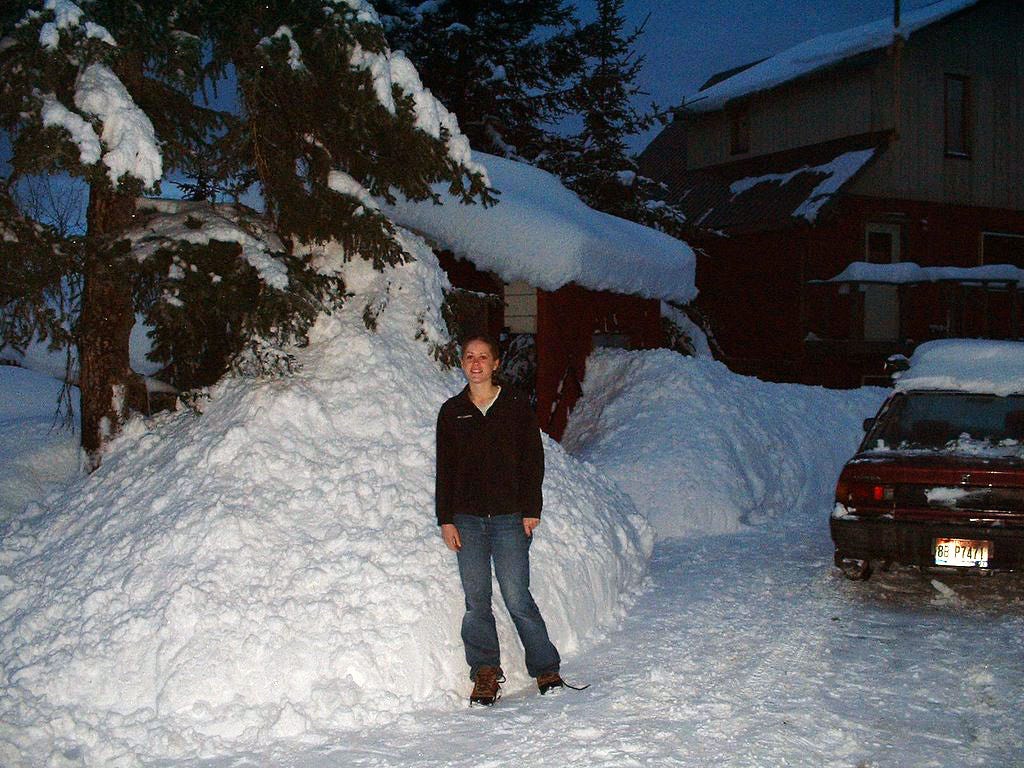
Maybe you can picture naive, 26-year-old Jill sitting in front of her desktop monitor in a crowded corner of the loft in a rented cabin in Homer, Alaska. Heavy flakes of snow are rapping against the window during yet another February blizzard, adding to the 60-plus inches of snow that cover the ground outside. She has lived in Alaska for all of five months, and she has recently completed her first-ever race — a 100-mile effort over the frozen swamps and rivers of the Susitna Valley, riding, walking, and sometimes dragging her mountain bike through deep snow for 25 hours.
The accomplishment is new and intoxicating. Her blog friends assure her that this means she’s strong and capable. Few people can endure the tedium, darkness, and cold uncertainty that she faced while training for and completing the race. She feels unstoppable. Then there’s this Karl Bushby, a bearded “grubber” sort of dude with an oversized push-cart. He likely swapped his cart for a sled to cross Alaska. But still … if he could do it, so could she!
She strikes up an e-mail dreaming session with a friend in Anchorage, imagining what it would take to plan an expedition across Alaska and Siberia. She, of course, knows little to nothing about geopolitics. The logistics are interesting enough. She and her friend trade links as Bushby and his recently recruited American partner, Dimitri Kieffer, tow 200-pound sleds onto the fractured ice and over 30-foot-high pressure ridges north of Nome. Later, the BBC would report on their plunges through thin ice, paddling in dry suits through 32-degree salt water choked with slush, and diving into sudden breaks to rescue their sleds before they were sucked beneath the ice. They came face-to-face with a polar bear. They slept on narrow ice floes drifting in the wind, sometimes pushed dozens of miles north as they tried to move west.
After 14 days and approximately 150 miles, they complete the 53-mile crossing and walk onto “Terra Firma” of the Chukotka. They are the only humans known to walk west across the Bering Strait in modern times. But as soon as they step onto Russian soil, the authorities arrest and detain them for failing to enter at an official checkpoint. The Russians are not amused and are unmoved by their feat of strength. The hikers are jailed, deported and, reportedly, banned from returning to Russia for five years.
It looks hopeless. Jill’s e-mails with her Anchorage friend peter out, and she turns her dreams toward her first summer in Alaska. She forgets about Karl Bushby’s adventure and doesn’t think about him again for 20 years.

As I read the NYT article on Thursday night, I didn’t make the connection to my 2006 fixation until I saw Karl’s selfie, and it all came flooding back. That’s him! The guy who almost convinced me I could walk across the Bering Strait when the world was so new and limitless! He actually finished his trek! But why did it take him another 20 years?
Recent articles about his triumphant finish only brush over the quiet years of his expedition. After he was deported in 2006, influential benefactors managed to convince Russian authorities to allow him back into the country. But for the next five years, he was only able to fund brief expeditions to Siberia, picking away at vast, empty stretches of tundra that he could only travel in the winter. In 2011, he inadvertently strayed into an off-limits zone and was again deported and banned. After that, he languished in his chosen waiting place, a small town in Mexico where he could live cheaply and largely by the generosity of friends. He spent his time walking dogs for cash, sleeping on couches, barely having enough to eat, and chasing sponsorships and permissions that only came sporadically. In all those years, he lived only for his commitment to his goal. He had resolved never to return to England if it couldn’t be under his own power on his chosen route. It was beginning to look like he would never go home.
All those romantic notions I unknowingly carried in my heart for 20 years, which occasionally emerged as a gnawing nostalgia, crashed through the floor of reality. What Karl Bushby accomplished was extraordinary: the ultimate (albeit sectional) thru-hike that will likely never be repeated. Geopolitical upheavals have made casual border crossings increasingly complicated. After the brouhaha of the 2006 Bering Sea crossing, Russia further clamped down on unofficial entry. Even if Russia didn’t create impossible restrictions, the changing climate has made ice and weather conditions so volatile that a Bering Sea crossing is virtually unsurvivable. As it is, Karl and Dmitri were very lucky in 2006.
So yes, it’s an extraordinary accomplishment. But was it … worth it? Of course, that’s a perspective that only matters to the person doing the thing. It’s not my judgement to make. When Karl left home in 1998, he left behind a broken marriage and an 8-year-old son. This situation was already fraught because military restrictions barred him from seeing his son in Belfast, forcing a prolonged separation. But his single-minded goal to stay out of England until he could return under his own power caused him to stay away for nearly three decades. His parents grew old, his son grew up, and his grandchild was born. His relationships remained distant and fractured. He dabbled in romantic relationships, but nothing lasted through the strange life he was pursuing. His was a chosen life of solitude, danger, discomfort, and poverty.
Karl recently completed his trek by swimming across the English Channel and walking the remaining miles to his hometown, where he’s going to see his mom for the first time in nearly 30 years. He looks forward to reconnecting with his son, who is now in his mid-30s, and a 12-year-old granddaughter he hasn’t yet met. He thinks he might want to spend his remaining years teaching or giving talks about the kindness of people he met along the journey. He’s 57 years old.
In one of his early interviews, Karl said he set out on his journey because he felt adrift and trapped by a predictable, mundane life that he felt unequipped to handle. These were fears I felt strongly in the mid-2000s. Most of the choices I made in my 20s were directed toward a desire to experience my life, not simply sleepwalk through it. I didn’t need success or fame or monetary gain. I wasn’t opposed to those things, of course. I’m human. But my primary goal was raw experience.
Lately, my nostalgia has drifted not through my actual experiences, but toward an imaginary future that formed when everything seemed almost limitless. The adventures I never had, the places I never found. As life happens, these dreams contract. It’s not just age and physical limitations. It’s not just time and monetary limitations. It’s how we change when our focus sharpens on what is truly meaningful to us.
My relationships mattered more to me than the prospect of unbroken freedom. I love getting to know a few places intimately rather than rush toward the futile goal of trying to see it all. My sense of self is anchored in the idea of having a home, a place that will forever hold the softest parts of me, a place I can always return to. My body is weird and breakable in ways that it was in 2006, but my weaknesses feel much closer to the surface in 2026. My nervous system isn’t equipped to handle constant discomfort and uncertainty. I’ve broken my body and mind enough times to understand the scope of my very real limitations.
Life continues to contract. And although we’ll never understand our infinitesimal smallness in the scope of all things, that truth becomes more apparent with every passing year. At the same time, our odds of being alive are equally infinitesimal. I strive to hold onto gratitude for this gift, even when I’ve grown tired and wonder whether I’ve slipped into sleepwalking without realizing it.
I was never going to be a Karl Bushby. He had so many unique experiences, yet few would want a life like that. The cost is too high. This is what I find most fascinating about his journey. He had to give up so much. How did he never change his mind? When I think about everything I’ve done in the past 20 years, all of the ways I’ve changed … and all that time, he remained on the same path. Waiting. Waiting and walking. Walking and waiting.
“Don't be afraid,” Karl urged listeners in a recent interview with CBS Evening News. “A bit of self-confidence will go a long way. Get off the couch. Get out of bed. Make it happen.”
That sort of inspirational messaging went down like soft ice cream in 2006. Hearing Karl effectively parrot himself 20 years later, I surprised myself with my middle-aged skepticism. Thoughts included, “My man, have you even noticed what has been happening over the past two decades?” And, “Did you actually learn anything out there? Something that goes deeper than ‘The world is big but kind?’”
I suppose there’s nothing wrong with noting the world is expansive, and most people are kind. It shouldn’t be more complicated than that. It just, you know … it just is. I suppose I’m projecting. If I dedicated 28 years to a journey to do something no one has ever done, I guess I’d want to emerge with some great insight. Not trite platitudes that don’t hold up to two decades of self-examination.
My return to Colorado has been a bit rough. I miss the Alps. I’ve had an allergy flare with asthma symptoms and red, puffy eyes. My knee has been stiffer and more painful, which I’m trying to blame on colder temperatures — this at least would mean the problem is solvable. I’ve slipped effortlessly back into my old routines, and there are evenings when I’ll watch the sunset and wonder where exactly my day went. I’ll plan a little bike adventure in the mountains, my knee will ache in the cold, and then I’ll return home to see that I’ve ridden the same route during the third weekend in October for four years in a row. It will suddenly feel less like an adventure and more like a habit I haven’t been able to break. And I’ll wonder, “Am I becoming an echo of myself?” I’ll wonder, “Am I sleepwalking through my life?”
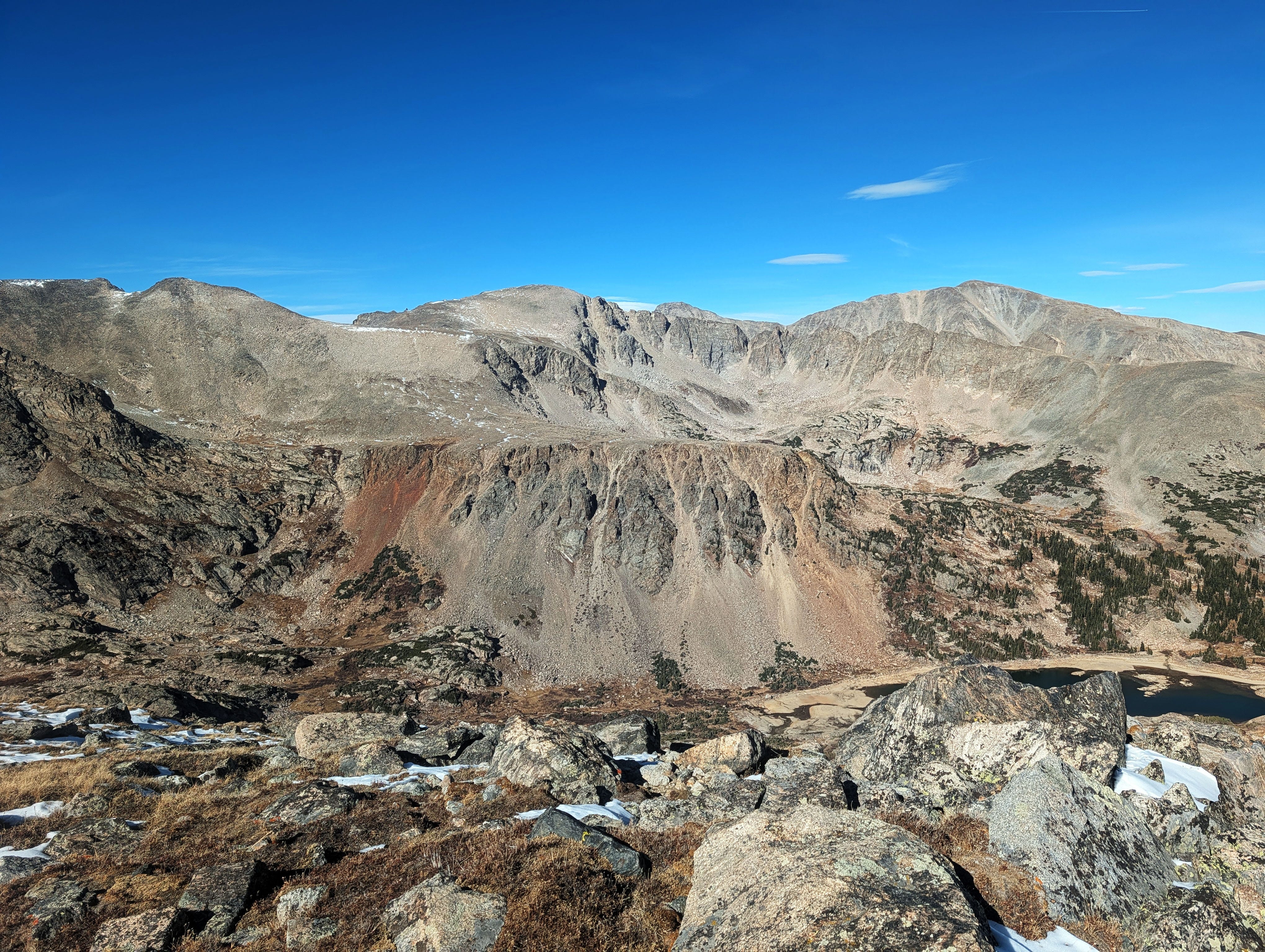
After two weeks of waiting for an appointment and repairs, my laptop is still broken. I should have Karen’d my way through the Apple Store, but instead, I returned to my “emotional support mountain.” Nearly three weeks had passed since my last hike in France, and I was tired of feeling incapable. So I wrapped my knee in my most robust fleece kneewarmer even though it was 52 degrees at the trailhead and set out. I can’t tell you how many times I’ve been up Niwot Ridge in the past 10 years. It’s a lot. But I love it here. Sometimes it’s the meanest place in the world, a whiteout of hurricane-force wind and blowing snow. The wind is so prevalent that Niwot is downright eerie when it’s calm, but the trail is reliably lonesome, always familiar, and I feel like I’m coming home.
I walked for five hours, felt strong, and soaked in the spooky warmth of late October above treeline in Colorado. My knee didn’t lock up. My breathing was steady and unpinched. I spent most of that time thinking about Karl Bushby, what his journey meant to me when I was 26, how it shaped my perspective, and what became of it … my life and his journey.
I have no great insight. Just thoughts about how compelling it is, the unique ways we all spend our one wild and precious life. And how we remain free to change and grow. And how grateful I am to have had 10 years to spend with Niwot Ridge, tracing its familiar patterns and feeling the connections we can only gain through experience.
It took 28 years, but Karl made it home. Perhaps that is what it was always about.
Thank you for writing about this in a much more nuanced and intelligent way than I would have.
Although if I ever do, I will be quoting this:
"If I dedicated 28 years to a journey to do something no one has ever done, I guess I’d want to emerge with some great insight. Not trite platitudes that don’t hold up to two decades of self-examination."
My brother sent me the link to the article on Karl last week. I thought I'd read/heard about a lot of 'Extremely Ambitious' (I say that in lieu of 'crazy') physical events over the years that I thought there wasn't anything anybody could do that would make me go "he did WHAT?" Until now. Boy, that's one that just "makes you go Hmmmm". And saying WOW is so not the correct word for what he did. Closer is the made-up word "Ginormous". But close only counts in horseshoes (and atomic bombs. I actually thought it was impossible to cross the Bearing Strait in modern times...never even considered the possibility that it was somehow possible, let-alone with 'stuff' and not some giant expedition with ships and rafts and porters and whatnot. Just Karl and his friend, doing the seemingly impossible (like the rest of it wasn't).
This is right there at the top of the list for bar-bragging. I did the Cross Utah. Ooh, Nice, I did the Tour Divide. Wow, those are both great. I did the Trans-America (the other 2 go quiet). And Karl, over at the end of the bar, quietly says "I walked around the world, including crossing the Bearing Strait with all my gear and a friend (oh, and I had to SWIM the English Channel to finally get home cuz they wouldn't let me walk thru the Chunnel). Only took me 28 years." Seriously, what would anybody possibly come up with that could top that? And you mentioned the dedication....no matter how hard it was, he'd take a break and then come-back. For 28 years. That ONE single objective, taking likely over a third of his entire-lifespan (assuming he lives to be 84 years old). I can't even really get a good grasp on what that requires to even take that first 'step'. Audacious is another good word, but that's Audacious to the nth power. It makes me feel small, miniscule even. What have I done? I'm not an overly religious person, but I'd think even God would be going "you did what?"
Anyway, another great post Jill, you cover a lot of areas in your life and life in general, always makes me thing and ponder the 'what-ifs'. I'm gonna have to file Karl's journey into some new mental folder that I don't even have a definition for, let-alone any other stuff to go with it. And continue breathing and riding and hiking and taking pictures, and living my life the best I can. Hopefully Guinness's Book of World Records adds him to their database, and maybe just for grins, try to make a list of the most-difficult to the least-difficult records to attain. It would be impossible to do, but the top of the list is easy. Below him it's a jumble of everything else with no clear order, only his entry is undeniable.
So Way to go Karl, but NOW what? Sheesh...I do a 3 or 4 day bikepacking trip, and the post-trip depression always sets in and I feel like I have to learn to live in society again.