
When it’s time to swim
A message in a bottle, from a mountain nine years ago

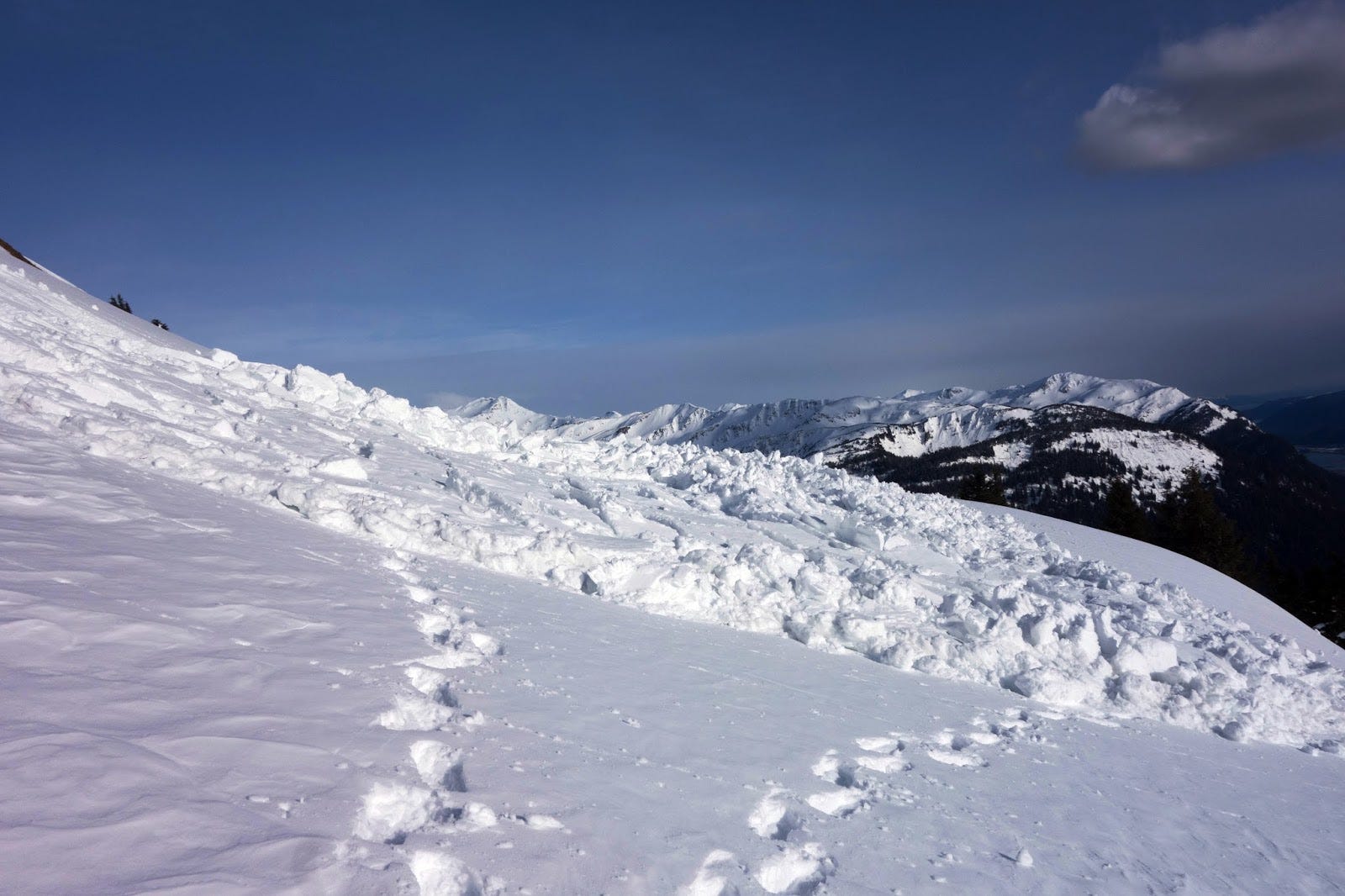
On March 22, 2017, I was caught in an avalanche.
The whole thing was so maddeningly banal. I was, for no good reason, snowshoeing near the alpine zone along the bench of the appropriately named Thunder Mountain near Juneau, Alaska. I wasn’t even supposed to be in Juneau. I was just killing time between two fights on a convoluted commute between Whitehorse, Yukon, and Anchorage. I checked into an airport hotel and immediately left for the nearest trailhead I could access on foot. I didn’t check the weather. I didn’t check the avalanche forecast. I wasn’t supposed to be there.
I heard a thunderclap and looked up to see an entire face of the mountain shattering like glass. At the ridgeline, at least 300 feet over my head, slabs of snow began to peel away. A voice said “run,” but I froze too long, fixated on the sound as blocks tumbled toward me. It was an unnatural sort of thunder that only grows louder. Finally, I ran. But I was running underwater. I was running in one of those bad dreams where a phantom is chasing you, but your feet are stuck to the ground. My snowshoes were plunging through the heavy snow, sinking to my knees, getting stuck under the crust. I never stood a chance. Even still, doubt managed to muscle through the noise — if only I were a better runner, or even just the old athletic self I used to be, not the sickly person I’d become.
When I looked up again, the shallow wall of snow was seconds from being on top of me. The calm I felt in that moment is mystifying. I mean, typically, I feel anxious over nothing at all. For me, anxiety is a nebulous shadow of doom that cannot be vanquished because it has no origin and no imperative. I get lost in the fog. But when facing down objective danger, my thoughts are sharp, and my Little Voice is clear. Running was done, so the soothing tone said, “Okay, it’s time to swim.”
I gripped both trekking poles and raised my arms, imagining how this might go. Flailing arms, kicking feet, reaching for the blue sky, fighting like hell to keep my face above the snow. But this was a wet slab avalanche. Boulder-like blocks, some the size of refrigerators, were tumbling and sliding down the single icy layer that remained after the slab broke away. A waist-high snow boulder slid toward me, and I instinctively scrambled up onto it. Then I was standing, looking down at my snowshoes as cracks spread beneath my feet. The way my brain recorded the next few moments, and the only way I can describe it, is that I was suddenly fording a whitewater creek. I needed to hop from crumbling rock to crumbling rock to avoid falling into the torrent. Chaos roiled around me, but I kept finding solid ground. When it finally slowed to a trickle, several inches of smaller snow rocks had buried my right foot a few inches above my ankle and instantly hardened like concrete. But my left foot was free, and my arms were free, and my hands were free, and I could see blue sky, and I was alive!
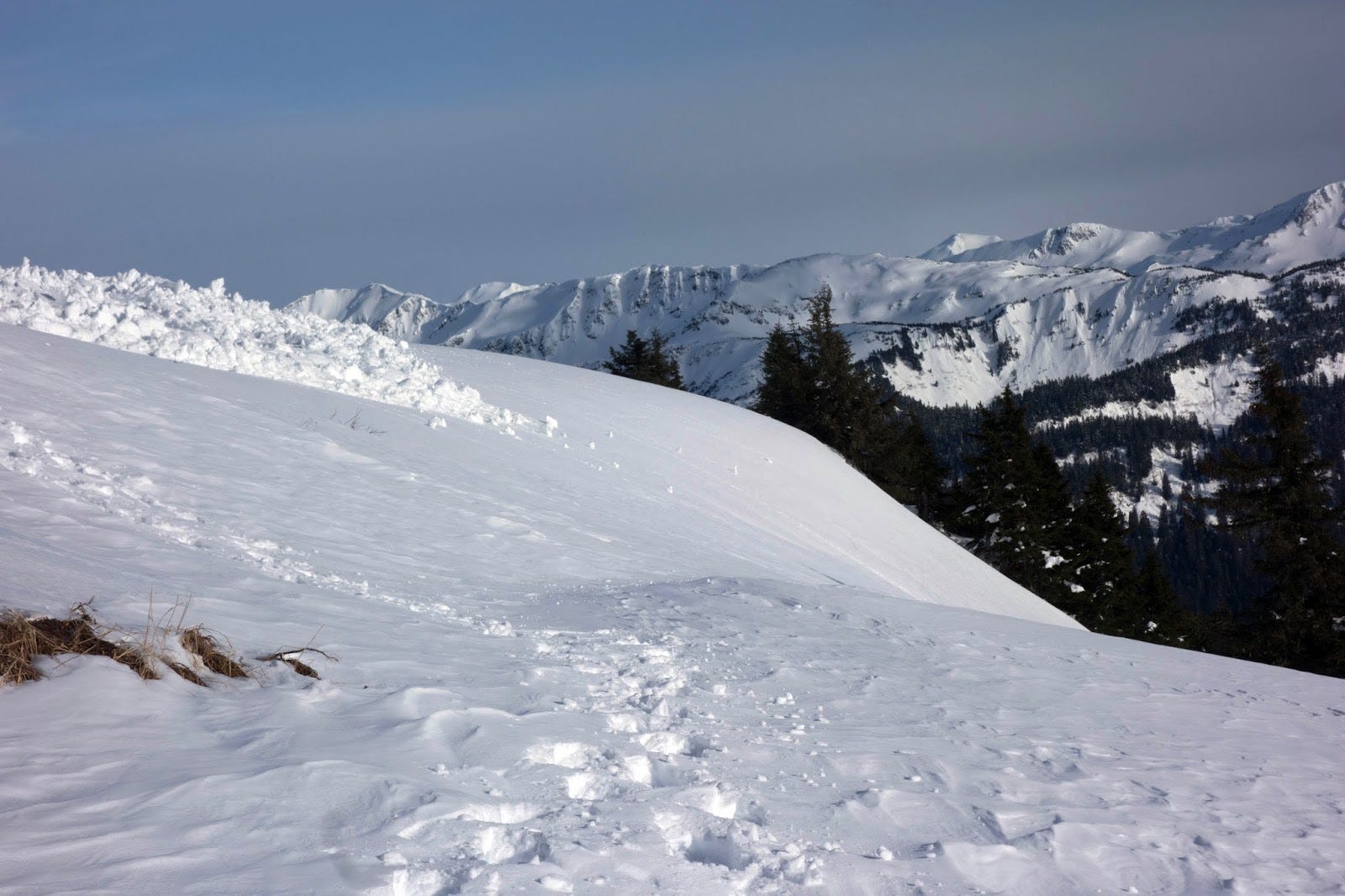
My right foot was stuck, though. It was really stuck. The calm in my head dissipated into the settling snow, and the floodgate of panic broke open. I chopped with my trekking poles and yanked my foot with such force that I badly strained my calf and quad muscles. I thought I was going to wrestle my foot out of my boot, and I was so frightened that the slide would start moving again that I was prepared to walk out wearing only a sock on my right foot. But the whole snowshoe broke out, a miracle! After I freed myself, I walked away in a daze, snapping only a few photos to mark my close call. That tranquil voice, which had been so soothing minutes ago, became loud and stern.
“Nobody would know.”
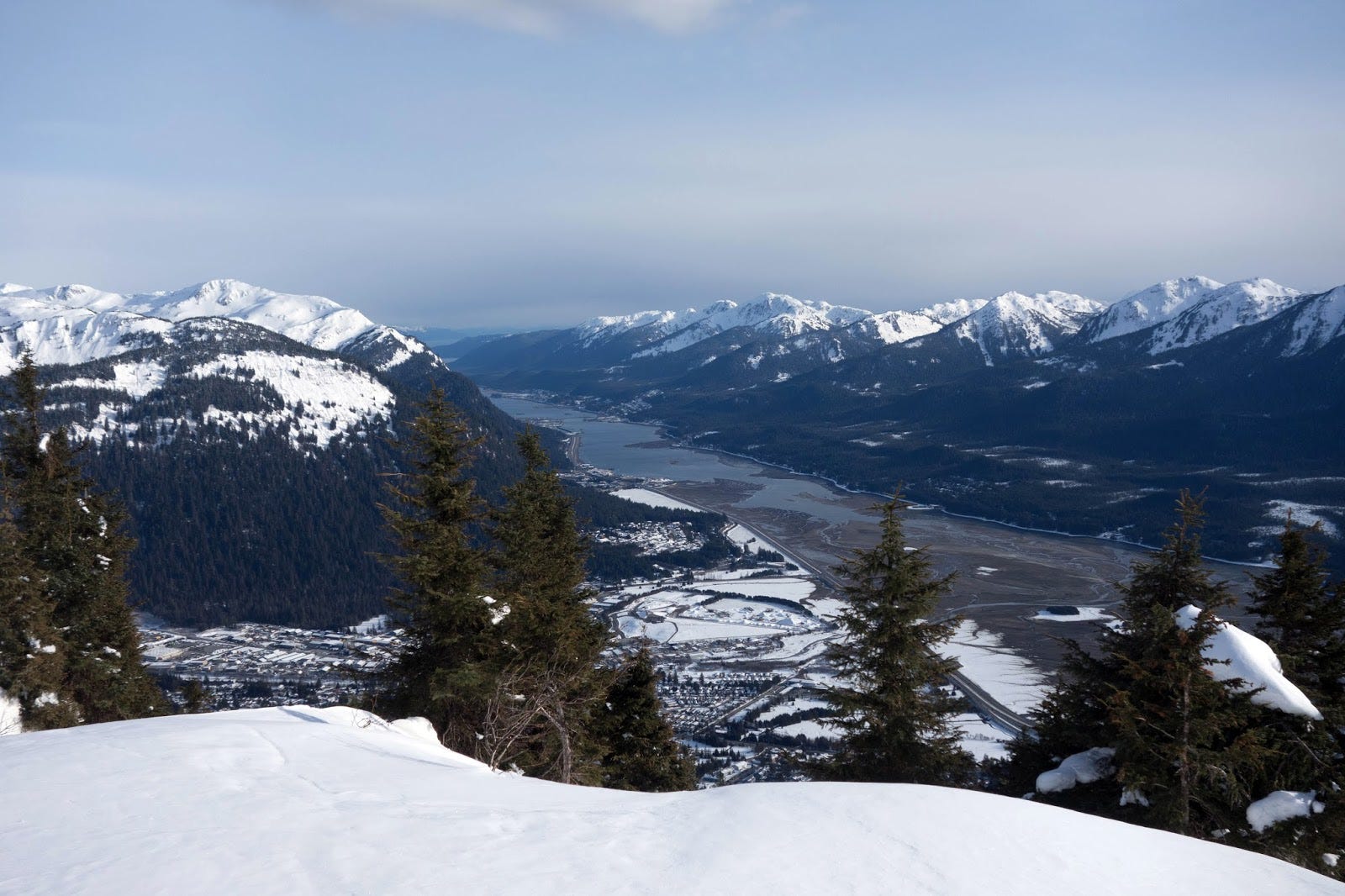
How did I end up in Juneau, the place where I used to live, on Thunder Mountain, the mountain I used to love, so much so that I wrote a series of blog posts about Thunder Mountain titled “Modern Romance?” The short answer is: I had a falling out with a former friend. We squeezed into her small truck with another friend to drive from Anchorage to Whitehorse. After an increasingly tenuous week, she refused to take me back to Anchorage. I didn’t want to spend another 14 hours in a vehicle with her anyway. I do not remember what our fight was about, only that we were mutually done and I was eager to find my own way home. Even if it meant coaxing my ever-gracious Canadian friend to drive me 100 miles over Klondike Pass and the US border, booking a small seaplane flight from Skagway to Juneau, and taking a commercial flight to Anchorage the following day.
The catalyst of all of that nonsense was the fact that I was mired in what I recognize now as unprocessed grief. This, in hindsight, probably made me an unfun companion on that Whitehorse trip, and it left me unhappy no matter what I did. But I was sick. I’d been sick for months, and I’d only recently found out the reason why. The diagnosis should have provided some relief, but I was still fixated on the absence of everything I thought I’d lost. I had been training for the Iditarod. I was supposed to spend that month riding my fat bike across Alaska, 1,000 miles to Nome. But my winter training had been abysmal. My breathing was so strained that I’d sometimes turn around after pedaling three miles. And my heart was damaged. I was sure of it. My heart was racing nearly all of the time, unless I tried to exercise, and then I couldn’t get my heart rate up at all. I’d choke and gasp up the tiniest inclines. I downplayed my concerns, because how does a 37-year-old admit she’s pretty sure she’s dying of congestive heart failure? Better to keep your mouth shut and let people think you’re crazy than open it and leave them with no doubts.
No, I just dumbly kept up my delusional training for my ridiculous dream of returning to my old athletic glory on the Iditarod Trail. It wasn’t until I traveled all the way to Fairbanks to prove to myself I could do it, struggling the whole time, and complaining to my physician friend Corrine about my woes, that she noticed a goiter on my neck. Within two weeks, I had a diagnosis of Graves’ Disease and reasonably severe levels of hyperthyroidism that meant I was perilously close to a thyroid storm — which can kill a person. My concerns were not unfounded.
The day I received my diagnosis was February 15, 2017, which is nine years, almost to the day, before I blew out my knee. In announcing my diagnosis of Graves’ Disease, I quoted a writer who described the experience as “crystallised in my memory as youth’s last day before, at the age of 34, old age struck me like a brick in a sock.”
And that’s exactly it. Although my health has improved in the decade that’s passed, Graves’ Disease was a definitive line between the effortless vitality of my youth and the management I’ve done since. I have hypothyroidism now and carry Hashimoto’s antibodies. My symptoms have been managed well with medication, but the disease is always there. It occured to me that blowing out my knee produced a similar sensation of being struck by old age like a brick in a sock. I was 37 and suddenly no longer young, and now I am (almost) 47 and no longer even that. I am going to be intensely superstitious about dates in mid-February from this point on.
Anyway, I was less than one week out from starting the Iditarod, which, I know … so ridiculous. I dropped out of the race but still went to Alaska because Beat was racing that year. I was on thyroid-suppressing drugs and beta blockers, which made me feel terrible all of the time. But feeling like you’re succumbing to lethargy is preferable to feeling like your heart might explode. I still pushed myself way too hard, because I suppose that’s what I do. Beat dropped out of the Iditarod early, but I stayed in Alaska, stubbornly keeping an aggressively “fun” routine of snowshoeing, fat biking, and taking that trip with my friends.
Only two people knew I was in Juneau at the time. My Canadian friend, who helped me hatch the convoluted escape plan. And my partner, Beat, who was back in Colorado, and whom I’d only vaguely informed via text message that I’d made it to Juneau and had an afternoon to kill, so I was going on a little hike. I had friends in Juneau, but I hadn’t contacted any of them to let them know I was in town because I was embarrassed by the reasons I was there.
Before my dazed hike down the mountain, I glanced back one last time at the avalanche debris. It was then that I realized how perilously close it slid to the edge. If it went off the edge, that would have been it. No amount of swimming can save a free fall. I thought, “No one would have found me before summer, if that.”
It was a strange, somewhat bemused realization — just how easy it can be to disappear. I laughed out loud. Little Voice was mad, though. I’d made a slew of irresponsible choices to put myself in this position. Those choices started with a devastating diagnosis and tumbled downhill, gaining momentum until I damn near wiped myself off the face of the Earth. And it was Little Voice who was left to wonder, “Why?”
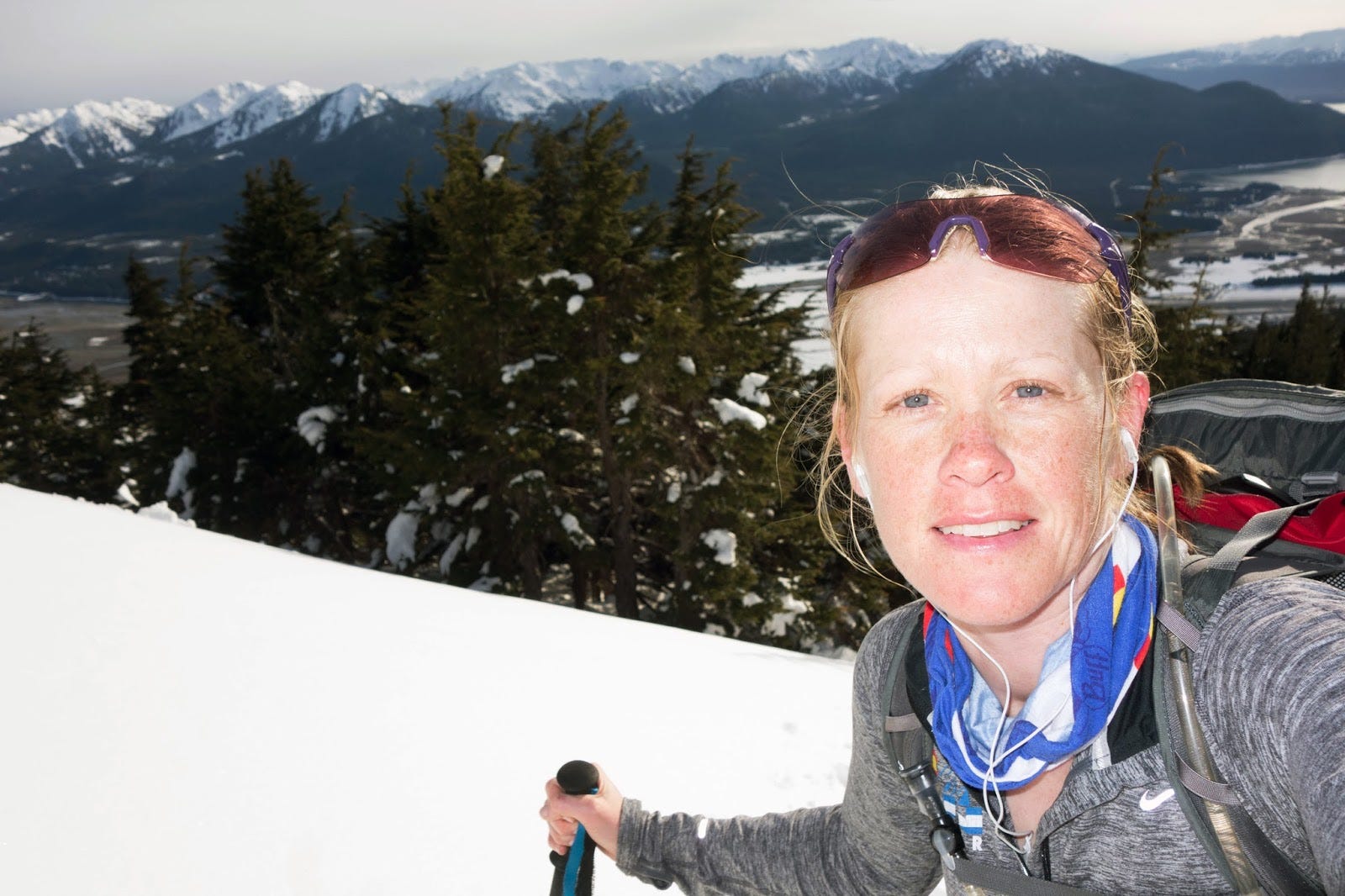
The avalanche has been on my mind because a friend recently asked if I’d ever genuinely believed I was going to die. I told her about becoming tangled in webbing and trapped underwater beneath an overturned raft in Cataract Canyon in 2001, and how I remain so terrified of water to this day that I can’t put my face beneath the surface of a swimming pool, which is why I don’t swim, which is a fun thing to explain to a physical therapist when I’m recovering from a knee injury. But when pondering mortality-inducing experiences, I tend to discount the avalanche. I was caught in a large avalanche. My foot was buried. I think I was a lot closer to the edge than I allowed myself to believe for a long time.
I don’t think I ever fully processed the avalanche because I was still so mad about thyroid disease, about another recent diagnosis of asthma, and about losing my athleticism and becoming “old” before my time. I had spent the entire hike mad — anger about the fight with my friend, anger about spending a bunch of money on this stupid escape plan, anger about dropping out of the Iditarod, anger about how difficult even hiking felt, anger at my beta-blocked heart that barely seemed to work, anger at my immune system that was attacking me on multiple fronts. Anger about a future I was certain I’d lost. By the time I snapped to attention and realized a wall of snow was coming toward me, there was a certain resignation to my reaction. A quiet “Well, here it comes.”
If it wasn’t for Little Voice and her calm imperative to “Run,” or her calm imperative to “Swim.” I wonder. The swimming … or what I did instead of swimming, which were the best rock-hopping maneuvers of my clumsy life … I believe saved me.
Little Voice asked, “Why?” So I’m thinking about the “Why.”
I’m writing about it today because I’m driving to Utah this week, so I finally made a new playlist for my trip. One embarrassing thing about me is that I still use iPod Shuffles and make playlists that will fit on a 2GB iPod Shuffle, which is about 250 songs. I also transfer these songs to a stick for my car, and it’s my current playlist until I decide it’s time for another. I made my last playlist to accompany the 50-mile trail race I ran in Moab in January. My Shuffle was stuffed in a hydration vest when I blew out my knee in February, and that hydration vest stayed stuffed in Beat’s car until I wanted to go for a ride two or so weeks ago and realized I couldn’t find my pack.
I admit to having an emotional few minutes when I found the vest, still covered in red dirt from when I was lying on the road. I pulled out the detritus that had been missing for nearly five months: A half-eaten and fully petrified protein bar, a buff I inherited from Betsy, my GPS tracker that I hadn’t needed because I hadn’t been off the grid in months, little packs of Christmas-themed Nerds Gummy Clusters that I brought home from the Arches 50. And, of course, my iPod Shuffle. I’ve been listening to it for the past two weeks, but it’s dredged up too much wistfulness for the old — I mean “not yet quite so old” me. The me who was still around in January. So I made a new playlist. Scrolling through the library, I stumbled onto “Moonn” by Radical Face, which is the song I listened to on repeat as I glided down Thunder Mountain in a daze in 2017. So I’ve been sitting here, pondering what it can teach me.
You are not you, you are a mirror
You only work when you’re the same.
But up here, the walls no longer reach me
I am not bound by where I'm from
I'm not awake, I am not sleeping as I walk along
The in-between of everything
What stands out is “You only work when you’re the same.” For all of the energy we spend clinging to images of ourselves, we rarely notice that they’re only reflections. These are stories we’ve built across decades, so naturally this is “who we are.” But we’re always moving. Always changing. Bodies become sick. Bodies get injured. We love. We lose some of the ones we love. We have incredible experiences. We forget. We forget a lot about our lives. And still we want it to be the same. We don’t want things to change. They already have. We’re already not who we were.
But we are still here, and that’s an incredible gift that I discount far too often. Because sometimes health setbacks, lost dreams, interpersonal drama, and rash decisions all converge to put you in the wrong place at the worst time, and the whole mountain starts to come down. But sometimes you just know that “It’s time to swim,” and you incredibly do exactly what needs to be done. In return, you’re given many more days.
I remember this from your blog! It is interesting to kook at situations we escaped. For instance there was a wildfire I probably should have died in but my Voice said to burn out a safety zone. I don't think I've fully processed that event either.