
While we feel strong
I’m ready to make some New Year’s Resolutions

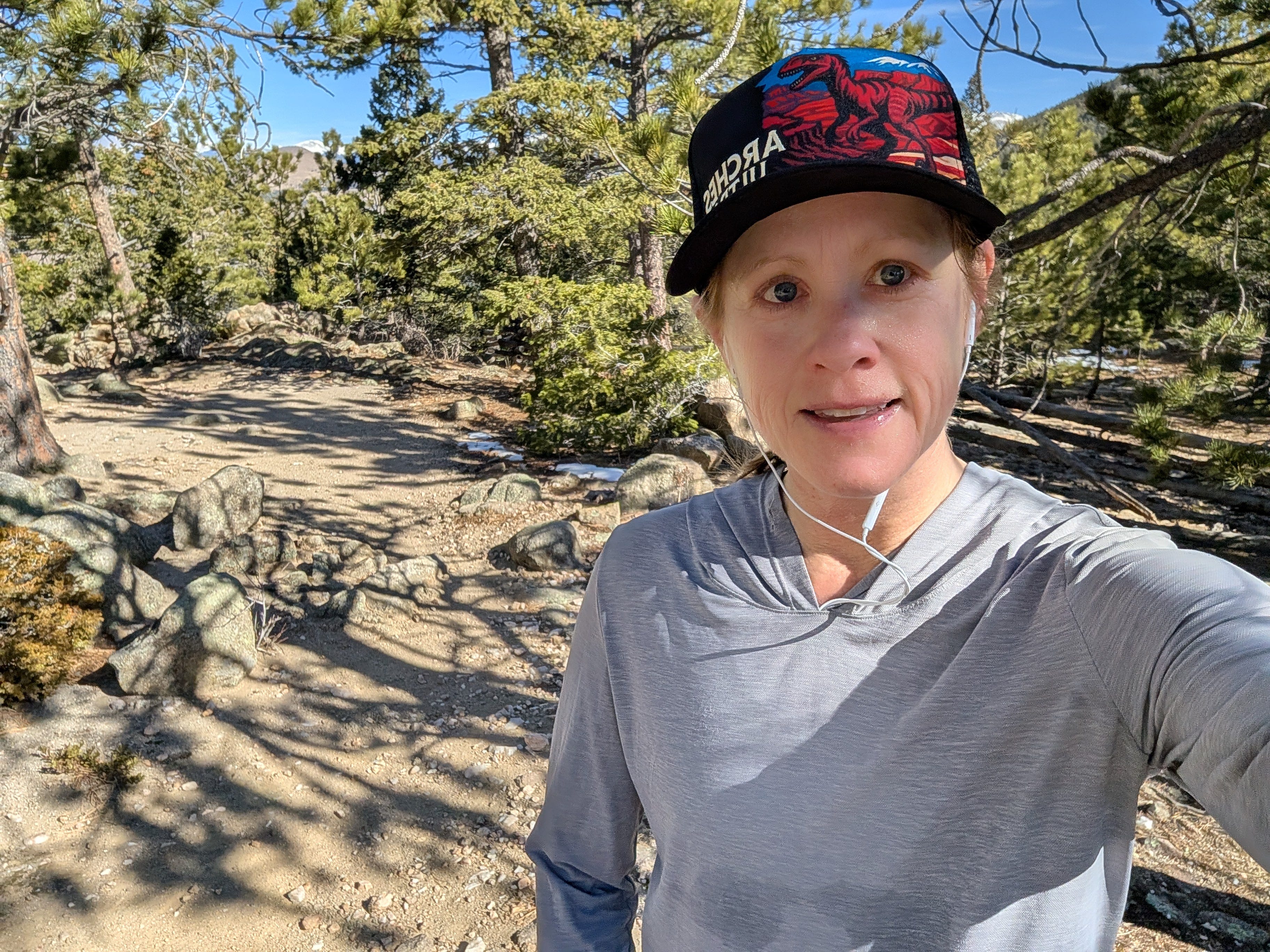
I was bounding down the Homestead Trail, feeling light on my feet as the springlike air warmed my legs. “I should not feel this good five days after 50 miles,” I thought. “There should be … something … here. Some evidence that I did anything at all.” There weren’t even whispers of fatigue. Just the heat and light and a strange February fitness that feels unearned.
My only theory is that, despite all evidence to the contrary, it is mid-winter. Groundhog Day came and went, and it was like, “whatever, six more weeks of the October that never ended.” More days of 60-degree sunshine. More days of no rain or snow. For parched Colorado, this is an ominous portent for summer. But to be perfectly honest, for somebody who loves the cold and snow, and who is terrified of fire summer, I’m not entirely missing winter this year. I had that Alaska adventure to remind me just how beautiful and brutal winter can be, and now I have all of the dry trails and sunshine without the asthma. It’s pretty amazing.
I’d guess that I’m near the bottom of my airway inflammation curve right now. The flare-up usually starts when certain tree pollens explode in April, accelerates through the poisonous grass season until August, then lingers through the wildfire smoke and particle pollution of autumn until the November winds take over, and I find myself miraculously able to breathe for a good four to five months. My breathing is especially strong right now because I don’t even need to deal with cold air. It’s like free everything: Energy, strength, stamina, confidence. Oxygen is a hell of a drug.
I was feeling so good that I headed out for a 20-miler through the hills on Saturday, wanting to keep up momentum and build running endurance for the 100-mile race I’m targeting on March 22. It’s a little funny because this is a snow-based winter race in Alaska. Running a good White Mountains 100 depends far more on luck (weather and trail conditions) than on aspects of racing that I can control (relative fitness). It’s also a race where cold-weather adaptations matter — something I am severely lacking thanks to my recent case of frostbite. But this oxygen saturation has me envisioning my best White Mountains 100 yet (10th time is the charm!), and I am determined to start pushing myself now that I’m less than six weeks out.
While skittering over the stunningly resilient ice across Forest Road 359 (how does ice hang on through so much warm weather?), I was dreaming up mantras to help sharpen my resilience this year. While my physical strength is up, it’s easier to feel more in control of my mental health. And with all of the uncertainties swirling around this year, cultivating resilience seems more important than ever.
Be adaptable. Flexibility equals strength.
It’s true for physical fitness, and it’s just as true for any aspect of life. My most difficult experiences in life have arisen from rigidity in my thinking or stubbornly adhering to my own expectations, only to have the mechanism snap under unyielding pressure. Life is going to apply this pressure no matter how strong I may think I am, so I need to be able to bend and change with it. Endurance racing has many good allegories for this, but it was Mike Tyson who famously said, “Everyone has a plan until they get punched in the face.” Accepting that these face punches are likely to come and being prepared to keep moving forward through the disorientation and pain is how we get through life.
Build resilience by building community.
Last year, I read a perspective-altering book by Soraya Chemaly called “The Resilience Myth.” The “myth,” Chemaly points out, is the rugged individualism of American culture — that we must rely on ourselves for strength, mental fortitude, and positivity. But “toxic individualism” has driven us into such division and despair that we’re damn close to driving our entire society off a cliff.
“Resilience is a complex relational process that emerges not from our independence from each other, but from our deep interdependence,” she writes. “Its opposite isn’t vulnerability or weakness, but loneliness and distrust.”
I tend to be someone who would rather rely on myself than risk all of the variables and unpredictability of trusting another person. I cultivated this thinking in my solo endurance racing and am always fiercely resistant to teaming up with another person, even when it’s undeniably in both of our best interests. I am also this way in my personal life, struggling to be fully honest and vulnerable with the people I love most. But I understand how my thinking has been flawed in this manner. I don’t become stronger by building walls around myself. Nobody does. People are difficult, especially for personality types like mine, but we have to trust each other. It’s our only hope.
You can see from the people of Minneapolis how important it is to be connected to your neighbors, open, and involved in your geographical community. I also want to work this year to be more supportive of my expanded communities — the outdoor lovers who are fighting to save public lands, the everyday athletes who share meaning in movement, the writers who still provide authentic voices as AI takes over the world, and the journalists who strive to seek the truth as our institutions crumble.
Make art. Just art.
I think about sketching when I remind myself how easy it is to create art, any time, anywhere. Sadly, I seldom sketch because I’m fiercely self-critical of what I create, and also, even more sadly, because there’s no validation in sketching. No one is ever going to see what I draw; nothing productive is going to come of it, so it’s hard to “justify” the time and energy that go into sketching. This is asinine. Sketching is no more or less of a waste of time than running, yet I prioritize running because there’s quantifiable achievement in the numbers I generate while running. But again, this is asinine. It’s all just time and energy and the subjective equations of prioritizing what “matters.”
For a few years in the early to mid-2010s, I was much more prolific with my writing. But my efforts tapered off dramatically when I started seeing writing through the lens of marketable products. After that, everything I did felt more and more futile. As I envision how I can get myself back into the space I was in 15 years ago — now that the markets have almost entirely dried up and AI is taking over what’s left — I can only conclude that it can no longer matter whether anything I create is profitable. I need to create it anyway, for the sake of creating. Like my sketches, even if I close the notebook and never open it again, its meaning lies in the act of creating.
Let go.
In April 2012, I was taking my brand-new beloved mountain bike on its maiden multiday voyage. It was an ambitious trail and fireroad tour from my home in Los Altos, California, to Santa Barbara, where Beat planned to run a 100-mile trail race. As I remember, my route was about 350 miles, and I gave myself three days to do it. My route, however, wasn’t the refined RideWithGPS and Komoot routes of nowadays; this was back in the before times when I still looked at paper maps via a California gazetteer and winged it. If a road is marked as existing on a map, it must exist, right? I used Google Maps to draw up a GPS route for my Garmin eTrex.
Unsurprisingly, nearly every mile of my route was much harder than I’d anticipated. Through the coastal mountains, long-disused fireroads cut straight up and back down fall lines: muddy, 25% grades that were littered with deadfall. Some of the dirt roads had been closed to vehicles for many years, reclaimed by landslides and fires. Many of my planned trails were closed to all use, gated, and plastered with scary no-trespassing signs. I got lost. I ran out of food, I nearly ran out of water, and I got caught in a rare coastal thunderstorm that was awe-inspiring in its violence. I made it as far as San Louis Obispo, pretty broken by the experience, and was able to call Beat for a rescue because his race had been cancelled due to flooding caused by that awe-inspiring rain. That was the trip that introduced the depth of vulnerability and isolation I could experience in what I thought was an overpopulated and wholly civilized state — vulnerability and isolation that can be found anywhere in this big, scary world. It was also the trip where I came across this bit of graffiti scrawled on a boulder that had plummeted off a hillside onto the highway, and then moved into a road pullout:
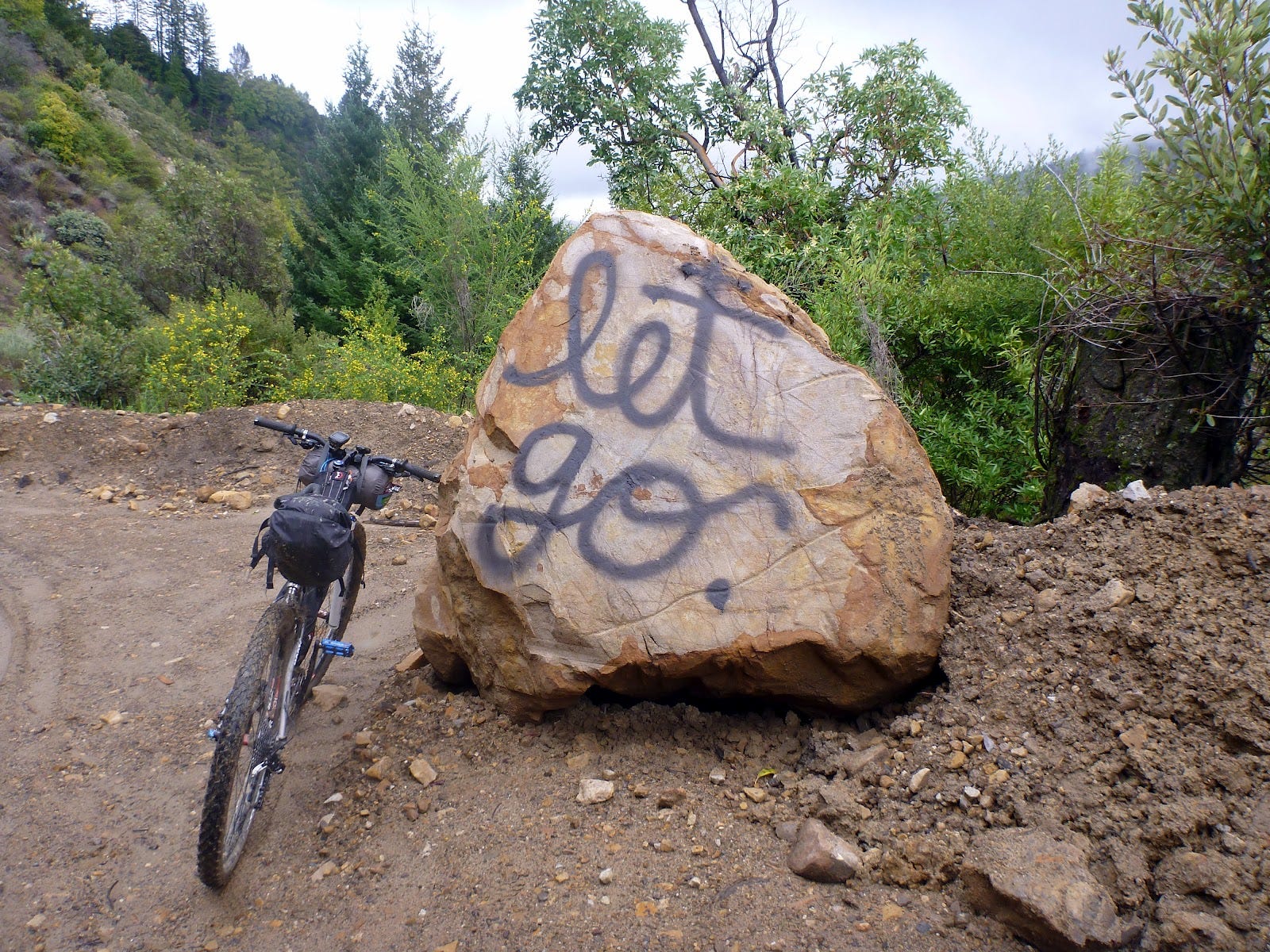
I encountered this boulder on the first day of my trip off of Skyline Drive, and thought about it many times over the next couple of days. I thought about it when I was lost on a dead-end road many miles from seemingly anywhere, so hungry I tried to steal an empty bag of Doritos from a crow, or watching lightning crack over the Pacific Ocean as I pedaled through the darkness on an empty Highway 1. “Let go. Just let go.” (This was also, I want to note, a year before Frozen and “Let It Go.” So I did not break into song.) It was the best mantra to calm my rattled nerves. I had chosen this, and now I had little control over my situation. All I could do was let go — let go of my pain, let go of my fear, let go of my hunger — and keep moving forward.
Every day is a gift.
Above all else, gratitude. Everything about existence is a miracle, and I’m so lucky to be alive. This is the truth I strive to hold onto when the void beckons and nihilism trickles through the cracks. Life is such a gift. Don’t waste it.
That’s what I have for now. I’m looking for more. What do you think is a good mantra for this downright bewildering year?
I honestly think we all need to be radicalized. The recent events in Minneapolis have exposed (shamefully, for me, very belatedly) the realization that as bad as things are now, they've been that bad or worse for marginalized people or people of color for a loooong time in this country. The murders of Renee Good and Alex Pretti are the tip of the iceberg. My mantra for this year would be "it's a good time to make good trouble."
You might check out Danny Gregory re: sketching. He has a lot of great advice about sketchbook art and just using it to document your life, no need for pats on the back! There are also some great street sketchbook artists on YouTube worth watching from time to time. I personally prefer making actual paintings on canvas or pastels on paper vs sketchbooks but have tried (and not stuck with it very well) doing a perpetual nature journal a few years ago. I'm currently doing some collage and junk journaling as a means of creativity, just to do *something* and get that mojo back.
I also appreciated your throw-backs to unoptimized route finding. Makes me think of the days of Map My Run in the 2000s.