
Walk unafraid
I’ll be clumsy instead. Injury day 84.

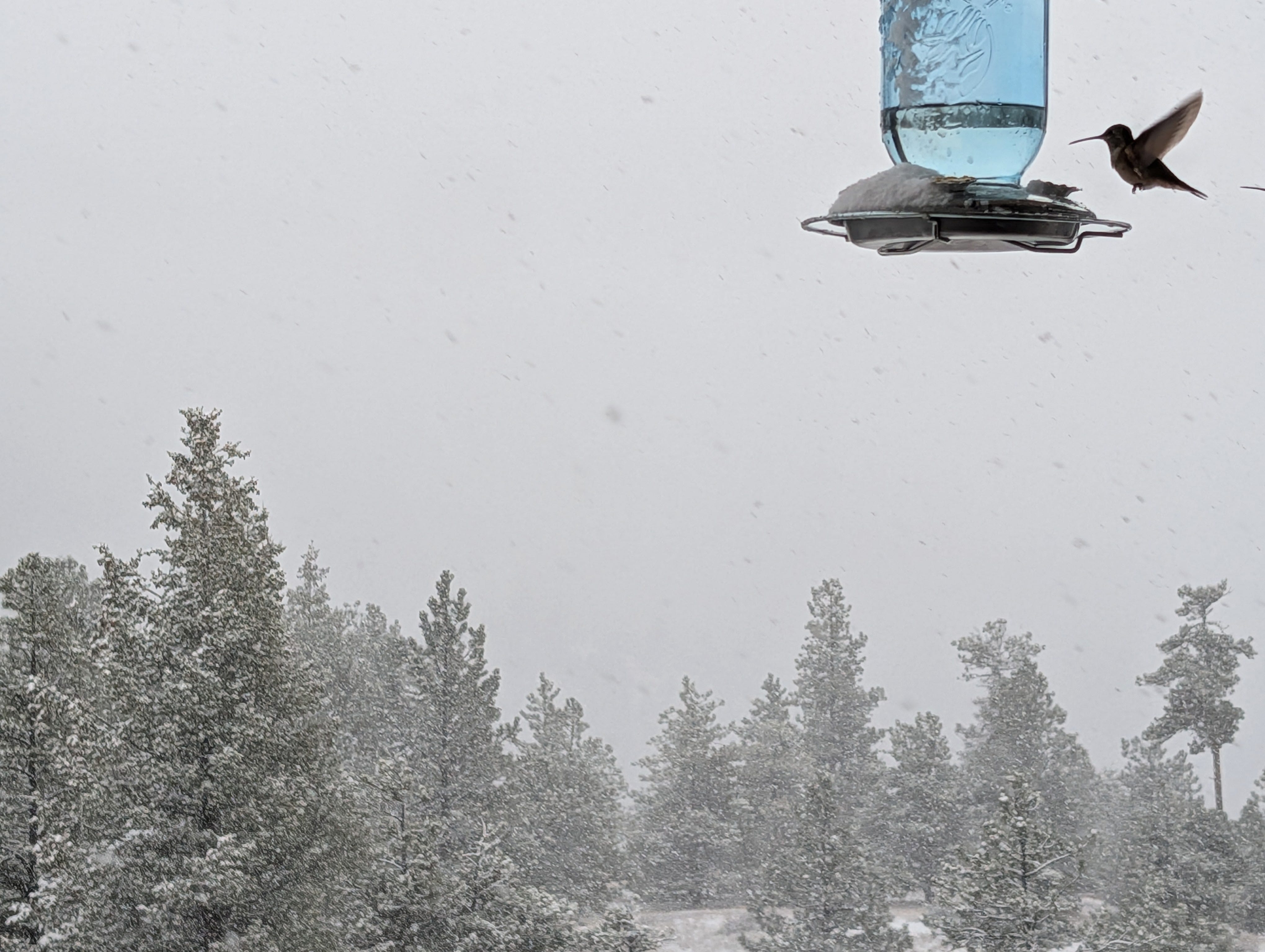
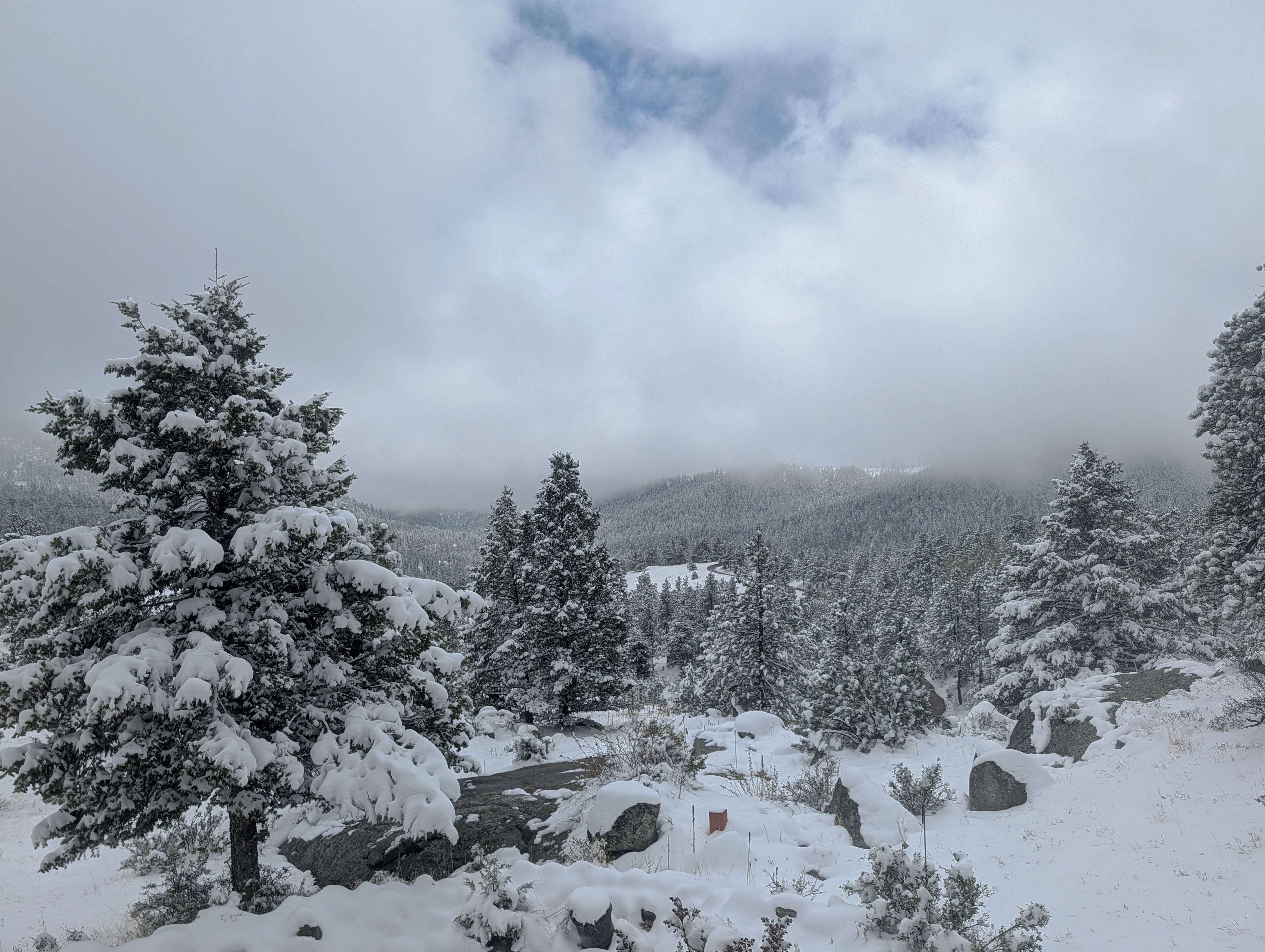
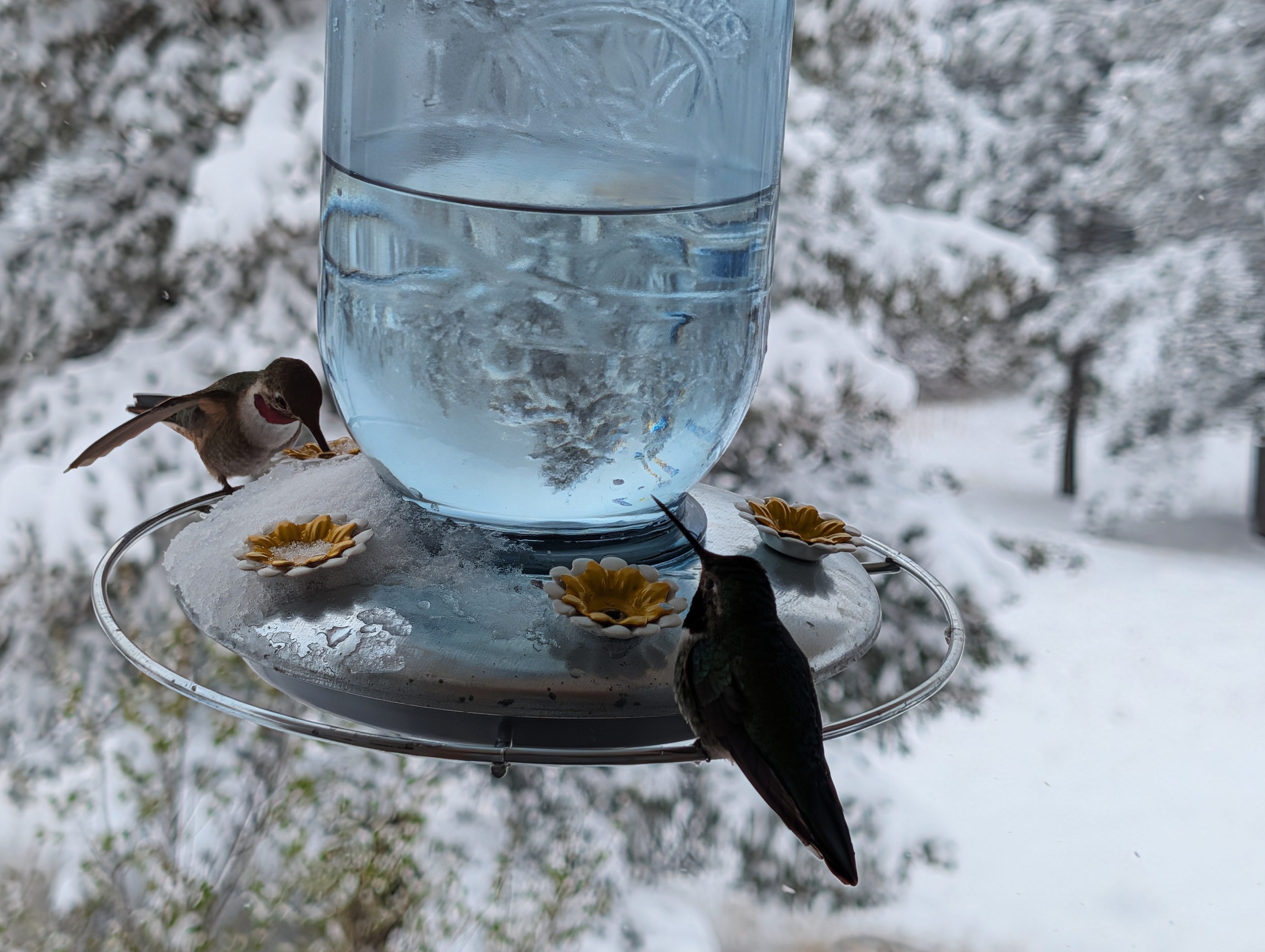
The absentee winter decided to do a drive-by in May. I pulled my PT mat up to the window to watch the hummingbirds fight to survive. The spring blizzard raged. Their tiny bodies stalled mid-air in buffeting wind gusts. With great strain, they clasped cold metal railings with toes as delicate as thread, then nosed through the accumulating snow to reach the “nectar” Beat had mixed for them. Air bubbles percolated through the feeders as they drank long and hard, filling bellies that looked distended but were probably just puffed-up feathers.
I appreciate more than most humans the sensation of glucose hitting my bloodstream when I’m out in the cold. I could vicariously feel the warmth flowing through my own hopelessly stiff muscles. Straight sugar, relentless motion, and an “oh shit” down parka have gotten me through many hard miles in subzero conditions. Hummingbirds come retrofitted with feathers and enviable metabolisms. They are built for the weather and seemed unbothered by this storm. But I fretted about them all the same.
What if their little feet froze to the feeders? What if the wind blew them into the window and they broke a wing? How do their tiny shoulder joints cushion the wear and tear of flapping their wings 50 times per second? I may need to look that up later. Animals’ ability to survive injuries in the wild has been a subject of much fascination recently. Because, as a human, without modern medicine and technology, I would have been dead so very long ago. As it is, I still have doubts that I’ll ever actually walk again.
Getting back on my feet 12 weeks into the injury of nature’s most questionably designed, structurally necessary yet nonvascular body part has been brutal. Don’t get me wrong; I’m able to do so much more than I was two weeks ago, and I’m grateful. I can stand at the counter and make myself a salad without needing to balance on one leg. I can carry things in my hands — no more grocery bags slung around my neck. I have mostly ditched the crutches, even though the lurching thing I do, which one might call walking, is still incredibly laborious and moderately painful. Sometimes I get up in the night and, remembering I left my crutches in the entryway, just can’t face the pain. Instead, I will lower my body to the ground and butt-scooch to the bathroom.
Walking. I want it so badly. You don’t even know. You don’t quite realize how much freedom this simple motion affords you until it’s gone. I have so much respect for adaptive mobility and the resilience of people who go through life with lower-limb limitations. When the pain of my meniscus tear and ITB Syndrome first put me on crutches, I hated them with the fire of a thousand suns. My shoulders hurt. My hands hurt. I had blisters above my rib cage. But after ten weeks, my shoulders were strong, my biceps looked fierce, and I could swing myself across a parking lot nearly as fast as other pedestrians were walking. At that point, I was told I must give up my crutches. This has paradoxically been just as difficult. So many things hurt again. The distance across parking lots again looks impossibly far.
The problem with returning to weight-bearing after 10 weeks is that it’s not just my knee that needs rehabbing. Sure, my knee still looks bad and feels bad and works bad, but it’s not even my problem. Despite my best efforts with PT, my lower leg has badly atrophied. My foot has weird neuropathies, a shooting electric pain when it hits the ground. And my calf muscles locked up so badly after my first couple of longer (one-mile) walks that I couldn’t hobble out of bed. Thus the butt-scooching.
But walking. I want it so badly. On Monday, my nice PT got my calf muscles firing, and I was able to walk reasonably well after leaving the session. So promptly overdid it with a 1.6-mile crutch-free effort through a gorgeous open space in Louisville. It was such a nice day. I was so happy to be outside. After that, I was deeply sore and back to hobbling indoors for the next two days while it snowed. On Thursday, after a demoralizing session with my mean PT (she is not really that mean, she is just unsympathic and she makes me work), I went to nearby Valmont Park to try again. Patches of snow still covered the grass, broken tree branches littered the paved path, and most of the park was closed to allow cleanup of storm damage.
“I am going to walk well,” I vowed. I focused on relaxing my upper body, swiveling my hips, bending my knee, and rolling through a full heel-to-toe flexion. Sadly, I could only concentrate on one mechanical goal at a time, and the rest of my body reverted to its stiff, lurching baseline. Within a quarter mile, I was experiencing the sort of full-body pain I only used to experience at the end of long ultramarathons. I couldn’t even catch up to a lady walking a tiny dog who stopped to sniff something every four seconds.
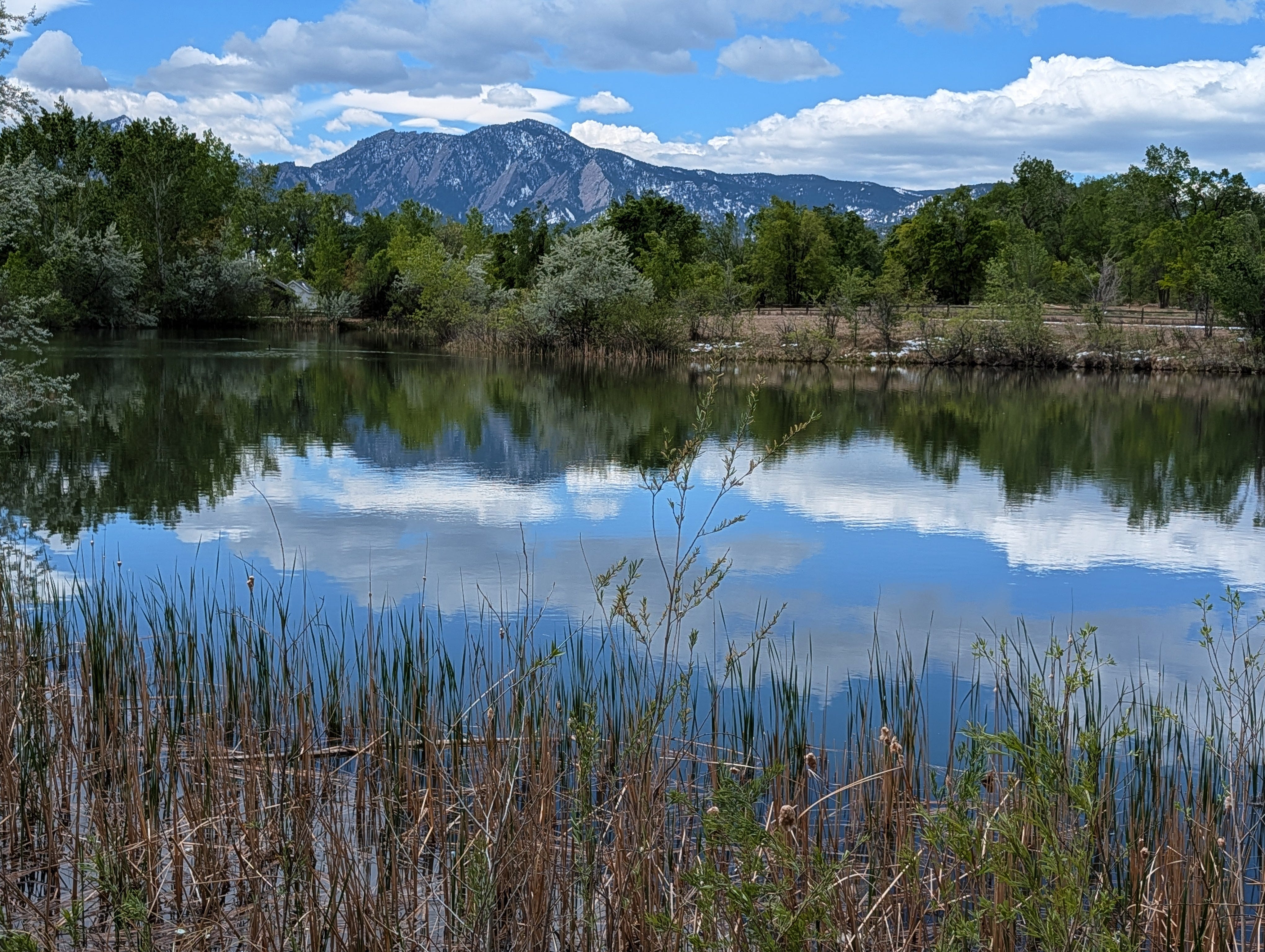
I stopped to rest at a memorial bench near the small lake. I admit I have forgotten the name of the person who died in 2020 at the age of 45, but I ran my hand over the plaque and said a quiet “I’m so sorry” for the people who loved them. I had been on the verge of tears since leaving PT, and let a few escape. Memorial benches can be a hair trigger for my grief, and everything feels so volatile right now. I gazed across the lake, a rippled reflection of spring green and the stunning snow-covered flatirons. I smiled at the thought that I used to pay good money and run long distances to feel this wrecked and demoralized in beautiful places. Now the hard physical challenge is instantaneous and free, but it comes without assurance that this particular endurance race has a finish line. I’ve been at it for twelve weeks. Grinding, grinding, grinding. Just to end up here, broken after a quarter mile.
Water splashed in the reeds just beyond the edge of my peripheral vision. As I turned to look, a Great Blue Heron launched from the surface of the lake with stunning force. The thrum of her wings echoed as she glided across the water to the opposite shoreline. I blinked in awe at this living dinosaur, her six-foot wingspan and long neck stretching toward the sky. Sometimes I want to give up, call the knee a loss, crawl into bed, and stay there. But I know the grind never stops being worth it, and I’m grateful for affirmation from these beautiful places I miss so much.
With renewed determination, I got up from the bench and continued my walk. I’d recently made a new playlist with any song I could think of about walking and recovering — “Walk” by the Foo Fighters, “Learn to Walk Again” by Bad Wolves, “Walk Again” by the Nicotine Dolls, “I Wanna Get Better” by the Bleachers. You get the picture.
In the way music often does, one of the songs transported me back to a time I’d nearly forgotten — 1998, the autumn of my second year in college. I’d recently moved out of my parents’ house to a shared room in a duplex with four strangers. It was fairly demoralizing time of my life when I was still trying to find my footing in my college education, working too many hours, not at all comfortable in my living situation, and briefly dating an older, 6-foot-8 man who I met at a dance club, and who turned out to be a terrifying stalker (he never hurt me, he only called incessently and kept coming around the house for several weeks after I asked him to stop doing either, and it was a bad enough experience that I can’t comprehend how so many women who have been through so much worse manage to cope.)
So, yeah, 1998, not my favorite year. But that autumn, R.E.M. released a song that I became a little bit obsessed with and made my anthem for a short time, then promptly forgot until now, 28 years later, after I scoured my memory for songs about walking.
As the sun comes up, as the moon goes down
These heavy notions creep around
It makes me think, long ago
I was brought into this life a little lamb
A little lamb
Courageous, stumbling
Fearless was my middle name
But somewhere there I lost my way
Everyone walks the same
Expecting me to step
The narrow path they've laid
They claim to
Walk unafraid
I'll be clumsy instead
Hold me love me or leave me high
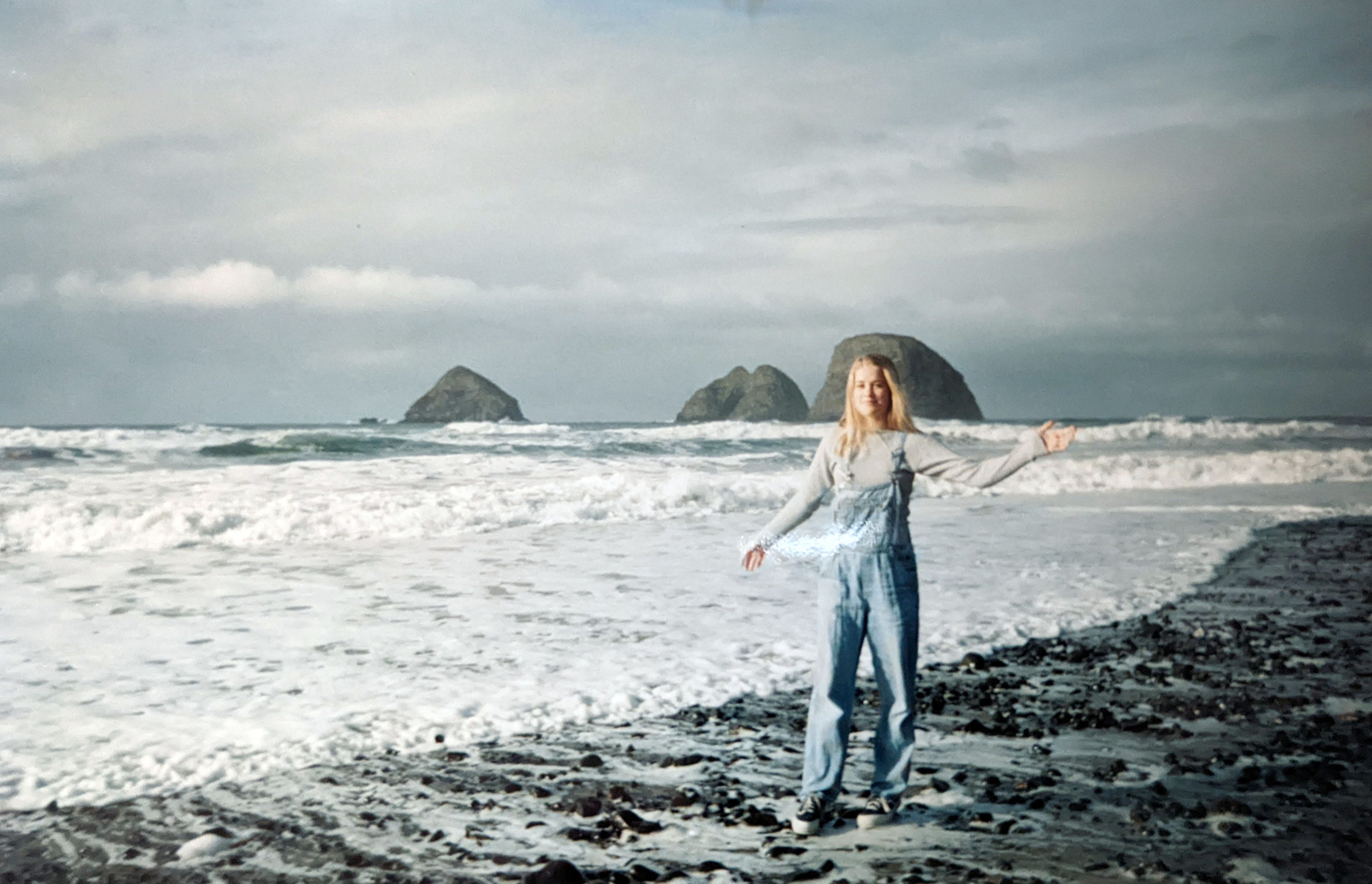
A meme that’s been floating around Substack recently reads: “I think midlife is just becoming who you were at 16, but loving her this time."
Perimenopause does feel a lot like a second adolescence, with ping-ponging emotions and rage and confusion and absolute bewilderment with my body. Now I have this injury that feels like a hard reset, and it’s still difficult to guess what life will look like on the other side. I’ve spent much of my adult life following this increasingly narrow path of a lifestyle until I hit this dead end. Sure, I might wander around in the dark for a while and pick up the same route farther down the trail. Or I might find something else entirely. It could be anything. There’s excitement in that — a sense of a vast and intimidating future rolling forward with no set course or even road maps to guide the way.
That’s how I felt in 1998, a bewildered 19-year-old who’d become hopelessly stuck on the narrow path she’d laid. So I talked several friends into piling into my Toyota Tercel to hit the road west to Oregon over Christmas break. My best friend from fifth grade had recently moved to Portland, and I used that excuse to visit my dream city. We had very little money and no idea where we were going — these were the days of Rand McNally Road Maps. I thought maybe I’d make a few new friends, make a few promising contacts, and find a way to uproot from my stuck life in Salt Lake City. It didn’t work out that way, but just taking that trip and figuring out that it was possible — that you can just do things — was a huge turning point in my early adult life.
Beat has been enjoying his first week of sabbatical, his “practice retirement.” But he also feels intimidated by the yawning unknowns of the future. It could be anything. I was doing my endless PT as he stood over my yoga mat and posited various projects he could work on. As his ideas became increasingly absurd, he paused. I shrugged. “Yeah, but is anything real anymore?”
“No,” he agreed. “Not really.”
R.E.M. knew what was up. You could rewrite the lyrics to “It’s the End of the World As We Know It” with lines about hauntavirus and the FIFA peace prize, and it would still hit the same as it did in 1987. Of course, you don’t even need to rewrite the lyrics for that song to hit the same, and that’s the point. We’ve always lived here, in the chaotic absurdity of life on Earth, flailing through endless uncertainties. The point is not to change the world. The point is to find the courage to live in the world as it is. To — as Rainer Marie Rilke wrote — let it all happen to you, beauty and terror. To live in the question. To live in widening circles that reach across the world. To just keep going.
To embrace honest clumsiness over false security. To trip and fall and pick yourself up. To walk unafraid.
been reading your work a long time. Your writing now is so good. Hope you turn it into a book. As usual, your adversity and pain are the raw material you craft into compelling narratives. Going through somewhat similar stuff myself. Thank you!
This has got to be the hardest thing ever: "The point is to find the courage to live in the world as it is." I've always lived trying to change things, now can I accept them? I cling to wanting/needing a sense of agency over it all...